
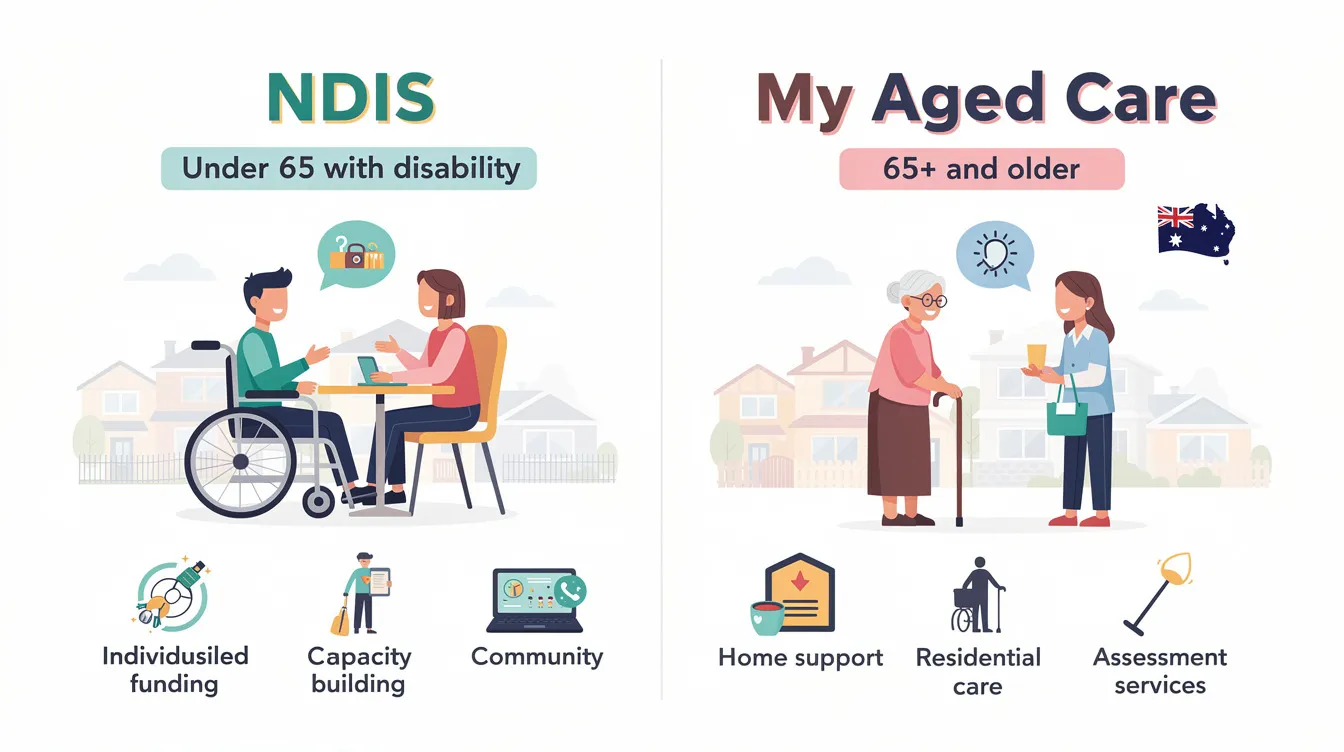
Australia runs two major government funded support systems for people who need help with daily life – and choosing between them isn’t really a choice at all. The National Disability Insurance Scheme (NDIS) supports people under 65 with permanent disabilities, while My Aged Care is the Australian government entry point for aged care services for those aged 65 and over. The deciding factor is almost always your age and the nature of your condition, not personal preference.
Still, the two systems differ significantly in how they’re funded, how much control you have, and what supports they cover. If you or a family member is trying to figure out the right pathway, this comparison breaks down the key differences so you can move forward with confidence.
The short answer: If you’re under 65 with a permanent and significant disability that significantly affects daily life, apply for the NDIS. If you’re 65 or older (or 50+ for Aboriginal and Torres Strait Islander people) and experiencing age related decline, My Aged Care is the correct system. Eligibility criteria – not preference – determine which system you access. In most cases, you cannot access both simultaneously for the same supports.
What Is the NDIS?
The National Disability Insurance Scheme (NDIS) is an Australian government program for individuals with disabilities that provides individualised funding so participants can access support services tailored to their goals and needs. Administered by the National Disability Insurance Agency, the scheme is built around participant choice and control.
Its defining strengths include:
- Personalised funding plans – NDIS funding is personalized based on individual goals, divided across Core, Capacity Building, Capital, and Recurring support categories
- Participant choice – NDIS participants can choose their service providers, manage their own budgets, and direct how funds are spent
- Capacity building focus – the scheme funds allied health services, therapies, employment support, and skill development alongside daily living supports
- Broad support range – NDIS supports include mobility aids, assistive technology, home modifications, therapeutic interventions, and community participation
As of 31 December 2025, over 761,442 Australians were NDIS participants, with individuals with autism as their primary disability making up approximately 43% of participants (Wikipedia).
What Is My Aged Care?
My Aged Care is the Australian government’s centralised entry point for aged care services, designed to help older Australians access aged care services in Australia as they age. The system coordinates services through approved providers based on assessed care needs, with a focus on helping people remain living safely in their own homes for as long as possible.
Its defining features include:
- Ageing-in-place philosophy – My Aged Care funds personal care and household maintenance tasks that help older adults maintain independence at home
- Structured service pathways – support ranges from entry-level help through the Commonwealth Home Support Program (CHSP) to more intensive care via the Support at Home program and residential aged care
- Provider coordination – My Aged Care coordinates services through approved providers, with assessments determining what level of care you receive
- Means-tested contributions – My Aged Care involves a means-tested framework for determining contributions to care costs, ensuring fairness based on financial circumstances
The aged care system underwent major reform when the Aged Care Act 2024 took effect on 1 November 2025, introducing a new regulator, updated quality standards, and the new Support at Home program that replaced Home Care Packages and Short-Term Restorative Care.
NDIS vs My Aged Care: How They Compare at a Glance
| Factor | NDIS | My Aged Care |
|---|---|---|
| Best for | People under 65 with permanent, significant disability | Older Australians (65+) with age-related care needs |
| Age eligibility | Under 65 at time of application | 65+ (50+ for Aboriginal and Torres Strait Islander people) |
| Nature of need | Permanent disability that impacts daily life | Age related decline or functional needs |
| Funding model | Individualised budgets; participant-directed | Government-subsidised services; means-tested contributions |
| Assessment | Evidence of disability, residency, and age; functional capacity assessment from 2028 | Aged care assessment via My Aged Care; face-to-face or telehealth evaluation |
| Participant control | High – choose providers, self-manage or plan-manage funds | Lower – services allocated by assessed need through approved providers |
| Key support types | Allied health, assistive technology, home modifications, capacity building, community participation | Personal care, domestic assistance, home support, nursing care, residential aged care |
| The headline takeaway: the NDIS offers more flexibility and individualised control for disability related needs, while My Aged Care provides structured, service-based support designed specifically for older Australians experiencing functional decline. |
Age Eligibility and Access Criteria
Age is the primary gateway to each system, and this is the single clearest distinction.
NDIS requires that you are under 65 at the time of application. You must also be an Australian citizen or permanent resident (or hold a Protected Special Category Visa), and you must have a diagnosed disability that impacts daily life – specifically, a permanent impairment that significantly reduces your functional capacity. Early intervention eligibility exists for some cases, particularly young children where timely supports will reduce future disability burden. NDIS applicants must be permanent residents of Australia.
My Aged Care is for Australians aged 65 and over. Aboriginal and Torres Strait Islanders can access My Aged Care from age 50, as can people who are homeless or at risk of homelessness. The system focuses on age-related functional decline rather than permanent disability, though the two can overlap in practice.
Transition scenarios add complexity. Existing NDIS participants who turn 65 can generally remain on the NDIS – the age requirement applies only at the point of application, not ongoing eligibility. Younger people living in a residential aged care facility can still apply for the NDIS if they meet disability criteria. And from 1 January 2028, the NDIS will introduce a standardised functional capacity assessment for new applicants, which may narrow eligibility for those with lower functional impact (Department of Health).
Winner: Neither – this isn’t a competitive factor. Age eligibility and access criteria are gate-keeping mechanisms, not advantages. Your age and the nature of your condition determine which system you enter. If you’re under 65 with a permanent disability, the NDIS is your pathway. If you’re 65+ and need aged care support, My Aged Care is where you start.
Funding Model and Participant Control
This is where the two systems diverge most sharply, and it’s often the most important factor for people who qualify for either (such as those approaching 65).
NDIS provides each ndis participant with an individual care plan containing budgets across four support categories. Core Supports cover daily living and community participation. Capacity Building supports fund therapies, employment training, and skill development through allied health providers and other supports. Capital Supports cover assistive technology, home modifications, and specialist disability accommodation. NDIS funding is personalized based on individual goals, and participants can self-manage funds, use a plan manager, or have the National Disability Insurance Agency manage on their behalf, so understanding your plan and managing NDIS funding effectively becomes essential. Supports must be deemed reasonable and necessary supports under the scheme’s guidelines.
My Aged Care operates differently. Rather than receiving a personal budget, your aged care assessment determines what level of services you receive, and the government subsidises your aged care provider directly. Individuals receiving aged care services may need to pay co-contributions based on income and assets – the system uses a means-tested framework to determine what you pay. My Aged Care assessments consider age and financial circumstances when establishing your support level and cost contributions (Moneysmart).
Winner: NDIS – for participant control and funding flexibility, the NDIS is clearly ahead. You choose your NDIS providers, direct your spending within plan rules, and have the option to self-manage. My Aged Care offers less control, though the new Support at Home program (launched November 2025) has improved flexibility compared to the old Home Care Packages system. The trade-off: My Aged Care’s provider-coordinated model can actually be simpler for older adults who prefer not to manage their own funding.
Assessment Process and Application
Getting into either system requires navigating an application process, and neither is particularly quick.
To apply for the NDIS, you complete an Access Request Form and submit supporting documents with your NDIS application – typically medical evidence, specialist reports, and functional assessments from allied health professionals documenting your permanent disability and how it impacts daily life. You can contact NDIS at 1800 800 110 to apply or to get help starting the process. After lodging, the National Disability Insurance Agency reviews your evidence and may request further information. Once approved, a plan is developed with budgets aligned to your support needs and goals. From 2028, a standardised functional capacity assessment will become mandatory for all new applicants, adding another step.
My Aged Care applications require a thorough assessment process that begins with the “Should I Apply?” online tool on the My Aged Care website. After registering, an assessor contacts you within 2 to 6 weeks to confirm your needs and arrange a face-to-face home visit (or telehealth if needed). The assessment evaluates your functional capacity across everyday tasks, safety risks, and overall care requirements. My Aged Care assessments consider age and financial circumstances to determine both eligibility and cost contributions.
Winner: My Aged Care – on process accessibility and clarity. The centralised online tool and structured assessment pathway make it more straightforward to begin, and the evidence burden is lighter (functional assessment vs. specialist medical reports). The NDIS application process is more complex, requires more documentation, and outcomes can be harder to predict. That said, My Aged Care’s 2–6 week wait for initial assessor contact – plus potential waiting lists for home funding or residential placement – means neither system delivers instant results.
Service Coverage and Support Types
Both NDIS and My Aged Care can provide personal care and assistive technology, but the scope, depth, and philosophy of supports differ considerably.
NDIS support categories span:
- Core Supports – daily living supports, support workers for personal care, community participation, transport, and consumables, forming the foundation of NDIS Core Supports
- Capacity Building – allied health services (physiotherapy, speech pathology, psychology), support coordination, employment training, and improved daily living skills
- Capital Supports – assistive technology, mobility aids, home modifications, vehicle modifications, and specialist disability accommodation, often delivered through assistive technology for independence
The NDIS supports independence and community participation for individuals with disabilities, with a strong emphasis on building skills and reducing long-term support needs through comprehensive disability services that promote independence. NDIS supports people across a wide range of disability related needs, from physical and intellectual disabilities to psychosocial conditions.
My Aged Care services include:
- Commonwealth Home Support Program (CHSP) – entry-level support including domestic assistance, household tasks, personal care, social activities in the local community, and transport
- Support at Home program – ongoing care for complex needs, replacing the former Home Care Packages. Support at Home is designed for older adults needing assistance with moderate to high care requirements, including personal care, nursing care, allied health, home modifications, and government-subsidised respite care
- Residential aged care – 24-hour nursing care, personal care, accommodation, and social support in a residential aged care facility for those who can no longer remain living safely at home
My Aged Care services include domestic assistance for seniors and other help with daily living activities for older Australians, and My Aged Care includes short-term care and respite services for both participants and carers. Support at Home provides ongoing care for complex needs, including complex care coordination, and sits alongside broader options for elderly care services at home that prioritise safety and independence.
Winner: NDIS – for comprehensiveness and service range. The disability insurance scheme NDIS covers a broader spectrum of supports, particularly in capacity building under the NDIS (therapies, education, employment support) and capital items (assistive technology, major home modifications). My Aged Care’s service coverage is solid for daily living and ageing-in-place support, but it lacks the depth of therapeutic and skill-building services available under the NDIS. For older Australians whose needs are primarily about help with household tasks, personal care, and maintaining safety at home, My Aged Care covers what matters most.
NDIS vs My Aged Care: Which Should You Choose?
- Choose the NDIS if you are under 65 with a permanent disability that significantly affects daily life, and you want access to disability services that promote independence. The scheme gives you individual funding, provider choice, and access to capacity building, allied health, and assistive technology supports tailored to your goals. To qualify for NDIS, a diagnosed disability must impact daily life in a way that is permanent or likely permanent.
- Choose My Aged Care if you are 65 or older (or 50+ for Aboriginal and Torres Strait Islander people) and experiencing age related decline, particularly if you are comparing aged care services in Melbourne or similar local options. My Aged Care focuses on age-related functional decline and provides structured support to help you maintain independence at home or access residential aged care when needed.
- If you’re approaching 65 and have a disability, apply for the NDIS before your 65th birthday, especially if you may later need Supported Independent Living (SIL) under the NDIS. Once accepted, you can generally remain an ndis participant after turning 65. Waiting until after 65 means your only option is My Aged Care, which offers less flexibility and does not cover the same breadth of disability support.
- If you’re a younger person in residential aged care, know that you can apply for NDIS if you meet disability criteria and may be eligible for Specialist Disability Accommodation (SDA) to move into a more suitable living environment. The NDIS can fund disability related supports even while you live in an aged care setting, though it will not cover general accommodation or daily care costs that fall under aged care.
Ultimately, this isn’t a question of which system is “better” – it’s about which system you’re eligible for based on your age, residency, and the nature of your support needs. Both systems are undergoing significant reform (NDIS eligibility tightening via functional capacity assessments from 2028; My Aged Care restructured under the Aged Care Act 2024), so staying informed and planning early is essential.
Frequently Asked Questions
Can I access both NDIS and My Aged Care simultaneously?
Generally, no. The two systems are not designed to overlap for the same supports. You cannot receive support from both systems for the same need – for example, you can’t have NDIS fund personal care while also receiving the same personal care through My Aged Care. In limited circumstances, there may be transitional overlap when an NDIS participant turns 65 or when a younger person in aged care receives NDIS disability support alongside their aged care services. But the supports funded by each system must address different needs and cannot duplicate each other.
What happens when I turn 65 if I’m on the NDIS?
Existing NDIS participants can usually remain on the scheme after turning 65. NDIS eligibility requires being under 65 years old at the time of application – once you’re accepted, turning 65 doesn’t automatically end your participation. However, your plan will continue to be reviewed regularly, and if your needs shift from disability related to predominantly age-related, some supports may eventually transition to aged care. Under upcoming reforms, all participants will undergo reassessment with the new functional capacity assessment over a three-year period starting in 2028. Planning ahead with your NDIS support coordinator or local area coordinator is advisable as you approach this transition point.
Can younger people in aged care access NDIS supports?
Yes. Younger people under 65 living in a residential aged care facility can apply for NDIS if they have a permanent disability that meets eligibility criteria. If approved, they can receive support through the NDIS for disability related needs – such as allied health services, assistive technology, or capacity building – even while residing in aged care. However, the NDIS will not typically fund general accommodation costs, daily nursing care, or other supports that are the responsibility of the aged care provider. Government policy actively encourages moving younger people out of residential aged care into more appropriate disability support settings where possible.
How do I know which system to apply for first?
Start with age and diagnosis:
- Under 65 with a permanent disability that impacts daily life → apply for the NDIS. You can contact NDIS at 1800 800 110 to begin.
- 65 or older (or 50+ for Aboriginal and Torres Strait Islander people) with functional decline or care needs → register through My Aged Care.
- Approaching 65 with a disability → apply for the NDIS before your birthday to maintain access to its broader support range.
- Unsure about your situation → speak with your GP or an allied health professional who can guide you toward the right pathway. For complex cases, a disability advocate, NDIS support coordinator, or aged care navigator can help clarify which system best meets your support needs.
Early planning matters. Both systems have waiting periods and documentation requirements, so starting the application process well ahead of when you need support will help you receive support sooner, particularly if you want a support coordinator to maximise NDIS funding.