
Choosing the right NDIS provider comes down to one fundamental question: how is your plan managed? Your plan management type – whether agency managed, plan managed, or self managed – dictates which providers you can access, what safeguards are in place, and how much flexibility you have over your support delivery. Understanding the differences between registered and unregistered providers is essential for every participant navigating the National Disability Insurance Scheme.
The short answer: A registered NDIS provider is the safer, more universally accessible option for most NDIS participants. Registered providers must meet NDIS Quality and Safeguards Commission standards, undergo regular audits, and can deliver supports to participants regardless of plan type. However, unregistered NDIS providers can offer greater flexibility and personalised service for self managed or plan managed participants who don’t require high-risk or specialist supports. Around 70% of NDIS participants can use unregistered providers, but the right choice depends on your specific plan, support needs, and comfort with oversight levels.
What Is a Registered NDIS Provider?
A registered NDIS provider is one that has been formally approved by the NDIS Quality and Safeguards Commission. Providers must apply to the NDIS Commission for registration, which involves passing an audit against the relevant NDIS Practice Standards, undergoing suitability assessments for key personnel, and obtaining NDIS worker screening checks for staff in risk-assessed roles.
Registration is granted for a three-year period, after which providers must complete a renewal process to maintain their status. During that period, registered providers must meet strict compliance standards, including ongoing reporting of incidents, complaints management, governance processes, and adherence to the NDIS rules around restrictive practices.
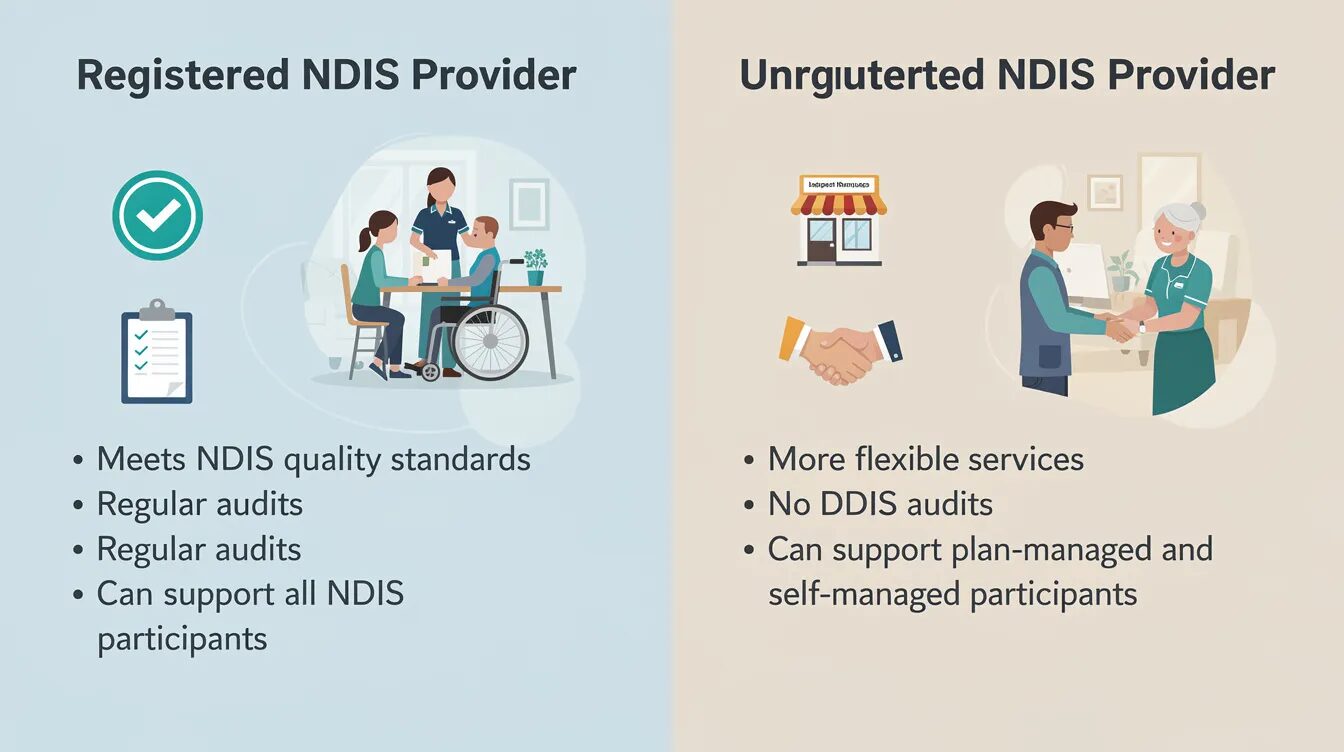
Registered providers can be found on the official NDIS Provider Register, which is publicly searchable. The register lists each provider’s registration status, approved service classes, and any banning orders or compliance actions – giving NDIS participants a transparent way to verify who they’re working with.
Registered NDIS providers can claim payments directly through the NDIS portal, and registered providers can deliver services to all participants regardless of plan type – whether agency managed, plan managed, or self managed. Registration enhances a provider’s credibility in the NDIS market and signals a commitment to high quality care.
What Is an Unregistered NDIS Provider?
An unregistered NDIS provider operates without formal NDIS registration from the Quality and Safeguards Commission. These providers have not undergone the audit process, are not listed on the Provider Register, and are not subject to the same structured regulatory oversight as their registered counterparts.
However, unregistered NDIS providers are not operating in a vacuum. They must still follow the NDIS Code of Conduct, which sets baseline expectations for safe and ethical service delivery. The key difference is that oversight of unregistered providers is largely reactive – driven by complaints and incidents – rather than proactive through independent audits and ongoing compliance monitoring.
Unregistered providers often include small local businesses or sole traders who deliver supports like community access, personal care, or allied health services. Unregistered providers can offer more personalized services and often have lower operating costs due to reduced administrative burden. They can still deliver quality personal care services and meaningful support, but without formal verification from the NDIS Commission, participants take on more responsibility for vetting their provider’s standards.
Unregistered providers can only serve self-managed or plan-managed participants – they cannot work with participants whose plans are NDIA-managed.
Registered vs Unregistered NDIS Providers: How They Compare at a Glance
| Factor | Registered Providers | Unregistered Providers |
|---|---|---|
| Best for | All participants, especially those needing high-risk or specialist supports | Self managed and plan managed participants wanting flexibility |
| Plan access | All plan types (agency managed, plan managed, self managed) | Self managed and plan managed only |
| Regulatory oversight | Audited against NDIS Practice Standards; ongoing compliance | Must follow NDIS Code of Conduct; no formal audits |
| Service scope | Full spectrum including SDA, SIL, behaviour support | Standard supports only; cannot deliver high-risk services |
| Pricing | Must comply with NDIS Price Guide limits | Can set their own rates (self managed); plan managed must stay within limits |
| Worker screening | Mandatory NDIS worker screening checks for risk-assessed roles | Not formally required, though Code of Conduct applies |
| Quality assurance | Verified through regular audits and Commission oversight | Variable; depends on individual provider practices |
| The core distinction: registered providers offer verified accountability and universal plan access, while unregistered providers offer flexibility at the cost of formal oversight. |
Market Access and Plan Management Compatibility
This is often the single most important factor in the registered vs unregistered NDIS decision, because your plan management type directly determines which providers you can use.
Participants with NDIA-managed plans can only use registered providers – no exceptions. The National Disability Insurance Agency requires that all supports funded through agency managed plans are delivered by providers who have undergone NDIS registration and meet the Commission’s standards. Registered providers can serve all NDIS participants, making them the only option that works across every plan type.
For self managed participants choosing between different plan management types, there is more flexibility in provider choice. Self managed plans allow participants to choose from both registered and unregistered NDIS providers for most support categories, and even to pay unregistered providers directly for services rendered. Plan managed participants also have this choice, with their plan manager handling invoicing and payments on their behalf.
The critical consideration here is continuity. If your plan management changes – for example, if your NDIS plan shifts from self managed to NDIA-managed – you would need to transition all your supports to registered providers. Any existing arrangements with unregistered providers would need to end, potentially disrupting established care relationships. Participants should factor this risk into their long-term planning.
Around 70% of NDIS participants can use unregistered providers because they are either self managed or plan managed. But that access isn’t guaranteed to remain unchanged across plan reviews.
Winner: Registered Providers – they offer universal access across all plan types and eliminate the risk of service disruption if plan management changes. Unregistered providers remain a viable option for the majority of participants but carry an inherent accessibility limitation.
Regulatory Oversight and Quality Assurance
The gap in regulatory oversight between registered and unregistered providers is substantial and directly impacts participant safety.
Registered providers undergo regular audits by the NDIS Commission. These audits assess compliance against the NDIS Practice Standards, which include a core module covering rights, governance, and service delivery, plus supplementary modules for higher-risk supports. Registered providers must also maintain NDIS worker screening checks for all staff in risk-assessed roles, notify the Commission of reportable incidents, and demonstrate ongoing compliance with service agreements and governance requirements.
The NDIS Quality and Safeguards Commission actively monitors registered providers through these independent audits, complaint investigations, and compliance enforcement. If a registered NDIS provider fails to meet standards, the Commission can impose conditions, suspend registration, or issue banning orders – all of which are publicly visible on the Provider Register.
Unregistered providers, by contrast, are not subject to formal systematic audits. While they must adhere to the NDIS Code of Conduct, enforcement is largely reactive. The Commission investigates complaints against unregistered providers but does not proactively assess their service quality, worker training, or governance practices. Unregistered providers do not provide the same level of formal safeguarding as registered providers, and unregistered providers face increased scrutiny from the NDIA as reforms continue to expand oversight.
For participants who prioritise verified NDIS quality and accountability, staying across major NDIS policy and provider regulation updates for 2024 makes the difference matter. Ongoing professional development, regular audits, and structured complaints processes provide layers of protection that simply don’t exist in the unregistered space.
Winner: Registered Providers – they provide verified compliance and accountability through independent audits and Commission oversight. Unregistered providers may still deliver excellent service quality, but without formal verification, participants bear the burden of due diligence.
Flexibility and Service Customisation
This is where unregistered providers offer a genuine advantage that registered providers often struggle to match.
Unregistered providers – particularly small local businesses and sole traders – tend to operate with less administrative overhead, which can make it easier to apply practical tips for managing your NDIS funding effectively. Without the compliance burden of ongoing audits, structured reporting, and standardised governance processes, they can offer more flexible arrangements: tailored scheduling, adaptable billing, services at unconventional times or locations, and a more personalised relationship with participants.
For NDIS participants with unique needs – whether that’s non-standard hours, specific cultural requirements, nutritional support needs, or a preference for a consistent one-on-one support worker – unregistered providers offer this kind of responsive, customised support delivery more readily, which can be especially valuable when arranging personalised NDIS-funded nutrition supports. They can adapt quickly to changing participant preferences without navigating layers of organisational policy.
Registered providers, while consistent and reliable, may have more rigid processes due to their compliance obligations. Service agreements, standardised procedures, and organisational governance can sometimes slow down responsiveness or limit the degree of personalisation available. This isn’t a reflection of poor service – it’s the natural trade-off of operating within a structured regulatory framework.
Unregistered providers can set their own rates and are not bound by NDIS pricing limits when working with self managed participants, which can work both ways: some charge less due to lower overheads, while others may charge above the NDIS Pricing Arrangements for premium or specialised services.
Winner: Unregistered Providers – they typically offer greater flexibility and personalised approaches to support delivery. Registered providers may have more standardised procedures, but participants who value consistency and predictability may actually prefer that structure.
Service Scope and Specialisation
Certain NDIS funded supports legally require a registered NDIS provider – there is no workaround regardless of how your plan is managed.
Under Section 73E of the NDIS Act, mandatory registration applies to:
- Specialist Disability Accommodation (SDA) for people with very high support needs – registration is mandatory for SDA under NDIS rules
- Behaviour support services, including the development of behaviour support plans – behaviour support services require registered providers by law
- Regulated restrictive practices – any support involving the use of restrictive practices
- Supported Independent Living (SIL) services – SIL supports must be delivered by registered providers
- Plan management – plan managers themselves must hold NDIS registration
- All supports for participants with NDIA-managed plans
Unregistered providers cannot deliver high-risk supports legally. If a participant requires specialist supports in any of these categories, only registered providers can be used.
For standard, lower-risk NDIS services – such as core supports for community access, general personal care, allied health therapies, or social participation – both registered and unregistered providers can deliver supports, provided the participant’s plan management allows it.
The NDIS sector is also shifting. From 1 July 2026, mandatory registration has been extended to SIL providers and all NDIS digital platform providers, including many services that help participants access assistive technology through the NDIS. The Securing the NDIS for Future Generations Bill further expands mandatory registration to cover all providers delivering high-risk supports and services to participants most vulnerable to abuse or exploitation. This trend means the scope of services requiring only registered providers will continue to grow.
Winner: Registered Providers – they can deliver the full spectrum of NDIS supports including specialist and high-risk services. Unregistered providers are restricted from these categories entirely, limiting their usefulness for participants with complex needs.
Registered vs Unregistered NDIS Providers: Which Should You Choose?
- Choose a registered NDIS provider if you have an agency managed (NDIA-managed) plan, require specialist supports like behaviour support, SDA, or supported independent living, want the assurance of regular audits and verified NDIS quality standards, or need a provider who can continue working with you even if your plan management type changes.
- Choose an unregistered NDIS provider if you are a self managed or plan managed participant, your support needs are lower-risk (community access, personal care, general therapies), you value maximum flexibility and personalised service delivery, and you’re comfortable taking on more administrative responsibility for vetting your provider.
- Consider a hybrid approach – many participants use registered providers for mandatory or high-risk specialist supports while engaging unregistered providers for day-to-day, lower-risk services where flexibility matters most. This allows you to benefit from the safeguards of NDIS registered providers where they count most, while retaining choice and personalisation in other areas.
For participants unsure of the best path, consulting an NDIS support coordinator can provide personalised guidance based on your specific NDIS plan, goals, and circumstances. A support coordinator can help you evaluate both registered and unregistered providers against your individual needs, provide specialist support coordination to maximise your NDIS funding, and ensure your choices align with NDIS guidelines.
The overall recommendation: for most participants, starting with registered providers – particularly for core and specialist supports – is the prudent foundation. From there, self managed participants and plan managed participants can explore unregistered providers for additional flexibility where appropriate.
Frequently Asked Questions
Can I switch from an unregistered to registered provider mid-plan?
Yes. NDIS participants can change providers at any time during their plan. If you want to move from an unregistered NDIS provider to a registered one (or vice versa), you can do so provided the new provider is eligible under your plan management type and for the specific support category. There is no need to wait for a plan review to make the change – simply establish a new service agreement with your chosen provider and inform your plan manager or support coordinator if applicable.
How can I verify if a provider is registered?
You can check a provider’s registration status through the official NDIS Provider Register on the NDIS Commission website. The register allows you to search by provider name or location, and shows their approved service classes, registration status, and any compliance actions or banning orders. Always verify registration before engaging a provider who claims to be registered – it takes only a few minutes and protects you from potential misrepresentation.
Are registered providers more expensive than unregistered ones?
Not necessarily. Registered providers must comply with the NDIS Price Guide and cannot charge above the published pricing limits. Unregistered providers can set their own rates when working with self managed participants – this means they may charge more or less than the price limits depending on their costs and the service. For plan managed participants, plan managers generally enforce the NDIS pricing limits regardless of whether the provider is registered. Using unregistered providers may involve more administrative responsibility for participants, including managing invoices and payments directly.
What happens if my plan management changes to NDIA-managed?
If your NDIS plan shifts to agency managed (NDIA-managed), you will be required to use only registered providers for all your NDIS funded supports. Any existing arrangements with unregistered providers would need to end, and you would need to transition to an established provider with current NDIS registration. This transition can disrupt care continuity, so it’s worth considering this possibility when building your provider network – particularly if there’s any likelihood your plan management could change at a future review.
Do both provider types have the same insurance and worker screening requirements?
No. Registered providers must ensure that all workers in risk-assessed roles obtain NDIS worker screening checks, and key personnel undergo suitability assessments as part of the NDIS registration process. These requirements are monitored through regular audits and ongoing compliance obligations. Unregistered providers are not subject to the same mandatory screening regime, though the NDIS Code of Conduct requires them to act safely and ethically. Participants engaging unregistered providers can – and should – request evidence of worker screening, insurance, and ongoing training to satisfy themselves that appropriate safeguards are in place.