
Your NDIS support should make your daily life easier, build skills, and move you toward your NDIS goals. But not every support worker or NDIS provider delivers quality support. Knowing what to watch for can protect your safety, well being, and independence before small problems become serious ones.
Key Takeaways
- Early red flags with NDIS support workers – repeated lateness, ignoring your NDIS goals, or poor boundaries – usually appear within the first two to four weeks of shifts.
- Participants, families, and support coordinators should trust their gut if a worker feels unsafe, controlling, or disrespectful.
- Serious red flags like financial exploitation, coercion, or abuse are non negotiable and should be reported immediately to the NDIS Quality and Safeguards Commission (1800 035 544) or police (000 in emergencies).
- Most providers deliver safe, respectful services – this article helps you spot the minority who don’t, and also outlines green flags of right support.
- You can change support workers or providers at any time, and this article explains how.
Understanding NDIS Support Workers and Why Red Flags Matter
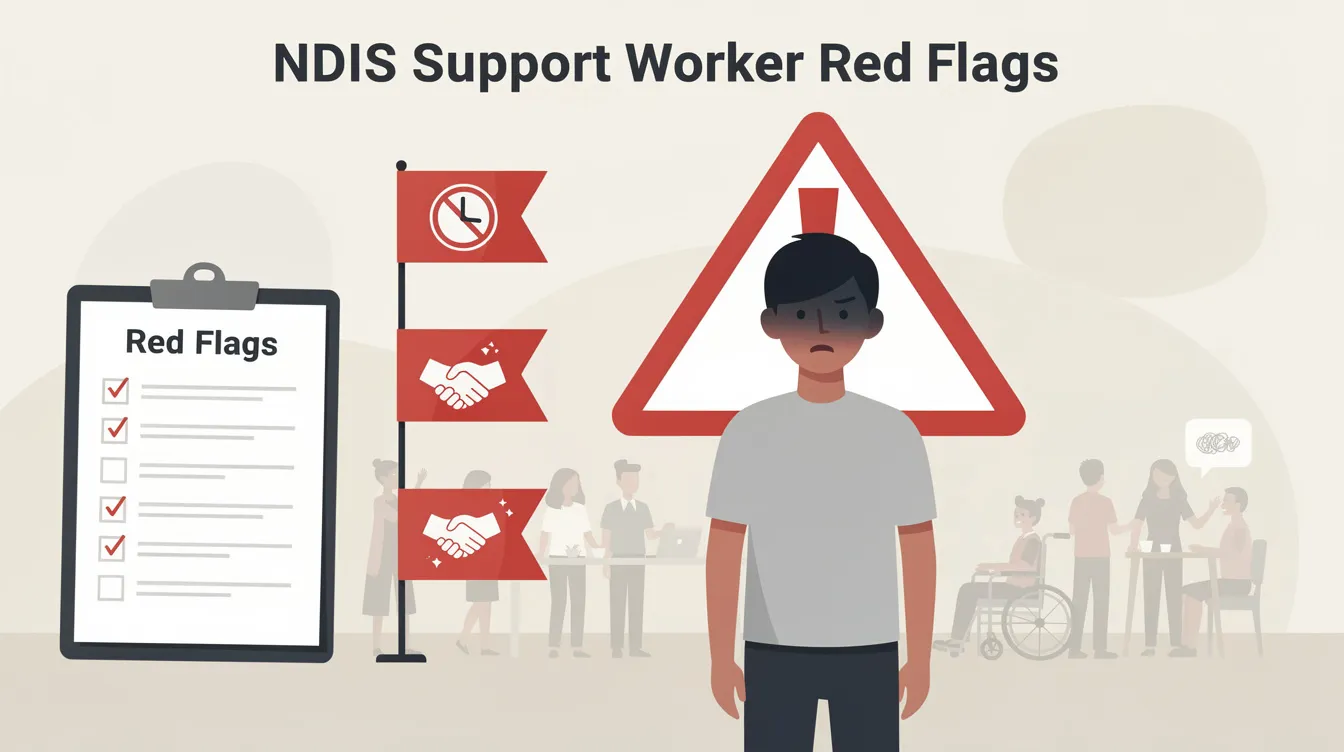
NDIS support workers and disability support workers help with personal care, community access, running errands, daily living tasks, and working toward your NDIS plan goals. Whether you’re agency-managed, plan managed, or self-managed, you deserve a worker who treats you with mutual respect and professionalism and shows genuine interest in your well-being, goals, and day-to-day support needs.
This article is for NDIS participants, families, and support coordinators across Australia. Most NDIS support workers offer quality support, but a minority display patterns that undermine your safety, independence, and confidence. In 2024–25 alone, 33,789 complaints were lodged nationally with the NDIS Quality and Safeguards Commission – roughly 45.7 per 1,000 active participants.
A red flag in this context is a repeated sign or serious incident showing a worker may be unsafe, unprofessional, or not aligned with the NDIS Code of Conduct. The Safeguards Commission is the national body overseeing complaints and provider behaviour. You have choice and control to change workers and service agreements at any time.

Early Red Flags in the First Meetings and Weeks
Many warning signs appear at the meet-and-greet, first session, or within the first two to four weeks. Spotting red flags early ensures physical safety and emotional alignment with your new support worker.
Punctuality and reliability:
- Frequent late arrivals indicate future reliability issues and unreliability in support workers overall.
- Last-minute cancellations signal a lack of commitment to support work.
- Inconsistent attendance can make participants feel insecure and disrupts routines and progress.
- Three or more red flags in four weeks suggest a bad match.
Attitude during the first meeting:
- Talking about the participant instead of to them.
- Not asking about routines, preferred ways of doing things, or NDIS goals.
- Dismissive body language – no eye contact, rushing the introduction.
- Feeling uneasy or pressured during interactions with a potential worker is cause for concern. Gut feelings about a candidate’s suitability should not be ignored during the hiring process.
Communication concerns:
- Examining communication styles during a worker’s interview can indicate their suitability for the role.
- Confusing explanations, not checking understanding, or ignoring communication needs such as Auslan, Easy Read, or assistive technology.
- Vague or defensive responses when asked about experience or approach.
- Effective communication about support and service agreements is critical in establishing clarity with hired workers.
Service agreement issues:
- Vague pricing structures and reluctance to put agreements in writing are red flags.
- A support worker or provider who refuses to give a written service agreement, avoids discussing cancellation terms, or is unclear about what is included in the NDIS support.
Credentials and screening:
- Identifying potential issues with an NDIS support worker requires looking beyond a standard resume. Standard certifications for NDIS workers include a Certificate III in Individual Support and First Aid.
- Incomplete or vague credentials can be a red flag during the hiring process. Red flags during hiring include a reluctance to provide identification or references.
- Resistance or delays in obtaining an NDIS Worker Screening Check are immediate dealbreakers.
- Checking references properly is crucial for evaluating a candidate’s reliability and past performance.
- Behavioural scenario questions and situational questions can reveal more than traditional interview queries – they help assess how a candidate would handle disagreements or stressful scenarios.
Subtle behavioural cues:
- Worker focused on their phone instead of giving full attention.
- Talking excessively about their personal life rather than your specific needs.
- Steering conversation away from your NDIS plan and goals.
If two or three of these red flags appear repeatedly within the first month, raise concerns with your support coordinator or NDIS provider.
Behavioural and Professional Red Flags During Ongoing Support
Some patterns only emerge after a worker has been supporting you for several weeks or months. Watch for these with your current support worker, especially if they are helping with community access, transport, and day-to-day independence.
Reliability:
- Regular no-shows, leaving early, or using shift time for personal errands without consent. Support workers should not use participant time for personal errands.
- Changing schedules frequently to suit the worker is a red flag – changing schedules to suit the worker undermines participant independence.
Boundaries and control:
- Support workers must maintain clear professional boundaries. Overstepping boundaries can create discomfort for participants.
- Making you feel like you need permission for everyday decisions indicates independence undermining. Support workers should not impose their way of thinking.
- Discouraging community connections or social connection with family, friends, or other providers creates dependence, not independence. Support workers should respect participant’s choices and independence and encourage participant independence.
- Controlling decision making around your schedule, contacts, or activities.
Personal care concerns:
- Rough handling, ignoring participant preferences, rushing hygiene tasks.
- Not preserving privacy – leaving doors open, exposing the participant, or making inappropriate comments.
Communication and respect:
- Speaking about the participant in front of them as if they are not there, using belittling language, or making jokes at the participant’s expense shows a negative attitude.
- Lack of communication creates misunderstandings and tension. Support workers should update participants on changes regularly. Clear communication is essential for a trusting relationship.
- Participants may feel left out without open communication. Support workers must listen to feedback from participants.
Safety and competence:
- Unsafe manual handling, misuse of equipment, not following medication instructions.
- A support worker’s lack of initiative can hinder participant progress. Refusing to learn specific support techniques needed for the participant’s disability is a concern.
Documentation:
- Not filling in required shift notes, refusing to share what was done during the shift, or being vague when family or a support coordinator asks for updates.
- Support workers should not share personal information inappropriately. Professionalism in support work prevents emotional responsibility shifts onto the participant.
- Support workers must respect participant confidentiality at all times.
Keep a simple diary – dates, times, and what happened – so you can provide clear information to your NDIS provider, support coordinator, or the Commission.

Serious Red Flags: When to Act Immediately
Some behaviours are non negotiable and require same-day action, particularly when they affect your mental health, wellbeing, and recovery support.
Financial and privacy red flags:
- Worker asking for bank cards, PINs, or passwords for phones or computers.
- Pressuring you to buy things for them or offering to “manage” your money. Understanding boundaries is critical for a support worker, especially regarding financial matters.
- Sharing your private information, photos, or address with other clients or on social media without written consent.
Coercion and exploitation:
- Threatening to cancel shifts if you don’t comply.
- Suggesting you exaggerate needs to access more NDIS funding.
- Pushing you to use only one particular NDIS provider without clear reasons.
Abuse markers:
- Shouting, intimidation, deliberate humiliation, physical roughness, sexualised comments or behaviour, or punishing the participant for saying no.
- The NDIS Code of Conduct emphasis es respect for individual rights when providing support services.
Real cases show why these matter. In one Western Australian case, a young mother lost over $36,000 to her support worker in just two months through financial exploitation, illustrating why accessing reliable NDIS information and resources and staying informed about recent NDIS policy and funding changes is so important for participants and families.
What to do right now:
- In immediate danger, call 000.
- For non-urgent but serious concerns, contact the NDIS Quality and Safeguards Commission on 1800 035 544.
- End the shift safely, move to a safe space, and document exactly what happened – date, time, who was present, and what was said or done.
Green Flags: What Quality NDIS Support Looks Like
Not every sign is a warning. Green flags show you’ve found the right support worker or provider delivering genuinely quality support.
- Reliability: Consistent punctuality, advance notice of changes, clear explanations about each shift, and where relevant, support from NDIS mental health recovery and community participation programs.
- Participant-centred practice: The worker talks directly to you, follows your routines, supports choice and control, and links activities back to your NDIS goals, including employment aspirations.
- Respect and dignity: Using your preferred name and pronouns, protecting privacy in personal care, asking permission before touching or moving items, and listening carefully to concerns. A good support worker should respect the participant’s rights and self-determination.
- Professional boundaries: Not oversharing personal problems, not asking for favours or gifts, keeping communication within agreed channels. A satisfactory candidate should demonstrate flexibility and respect for the participant’s unique needs.
- Transparency: Good NDIS providers and support coordinators encourage questions about service agreements, invoices, and how supports will be delivered, and may also connect you with Centres for Independent Living and peer-led disability advocacy. An NDIS Worker Screening Check is mandatory for registered providers and recommended for self-managed participants.
- Provider professionalism: Providers who invest in professional online presence, build strong relationships between workers and participants, and maintain clear communication channels often reflect the same standards in their support delivery, similar to employers actively recruiting quality disability support workers.
Discuss with your support coordinator or family what green flags matter most – gender of worker, cultural background, language, specific skills – and record these in the service agreement.
What to Do If You Notice Red Flags
You have the right to feel safe and feel comfortable. You do not need to put up with poor or unsafe support.
Step 1 – Speak up calmly: Raise concerns directly with the worker, giving specific examples. See if their behaviour changes over a couple of weeks.
Step 2 – Escalate to the provider: If things don’t improve, or if the issue involves safety, money, or serious disrespect, contact the service provider’s office or team leader. Refer to your service agreement.
Step 3 – Involve your support coordinator: A support coordinator or plan manager can help you review supports, document concerns, advocate for your best interests, and plan a safe transition to a different worker or NDIS provider.
Step 4 – Change workers or providers: Check notice periods in the service agreement, request a different worker, or find a new provider via the NDIS website or local community networks.
External support options:
- Disability advocacy services via the Disability Advocacy Finder
- 1800RESPECT (1800 737 732) for abuse or coercive control
- NDIS Quality and Safeguards Commission for formal complaints
Documenting dates, times, and incidents makes it easier for providers, coordinators, and regulators to act quickly. You deserve support that helps you achieve your NDIS goals, build confidence, and lead a life of greater independence.

FAQ: Common Questions About NDIS Support Worker Red Flags
How many red flags should I see before changing support workers?
One serious incident – such as abuse, financial exploitation, or a major safety breach – is enough to act immediately. For lower-level concerns like mild rudeness or a single late arrival, talk to the worker once and watch for improvement over the next few shifts. If the same issue happens two or three times within a month, or several different red flags appear together, it is reasonable to ask for a change through your NDIS provider or support coordinator.
What if my family likes the worker but I don’t?
Under the NDIS, the participant’s comfort and choice come first, even when family members are involved in decision making. Try explaining to your family how the worker makes you feel, using specific examples rather than general statements. A support coordinator, LAC, or trusted advocate can help mediate and ensure your preferences are the priority.
Can I end a service agreement early if there are red flags?
Most NDIS service agreements include a notice period – commonly 7 or 14 days. In cases of serious misconduct or danger, providers may waive this period. Ask your support coordinator or advocate for help, and keep written records of cancellation requests and reasons in case of disputes about charges.
How can I prepare for a first meeting to spot red flags early?
Write a short list of questions about the worker’s experience with similar disabilities, approach to personal care, communication style, and how they support informed choices and NDIS goals. Bring a copy of your NDIS plan or key goals, and watch whether the worker asks clarifying questions. Having a trusted person present – family, friend, or support coordinator – means someone else can also notice early signs in behaviour or attitude.
Are there red flags specific to self-managed or privately hired workers?
Self-managed participants hiring workers directly should watch for lack of insurance, refusal to sign a written service agreement, or resistance to providing an ABN or basic screening checks. Unregistered workers can still deliver excellent support work, but they should follow the NDIS Code of Conduct and be willing to discuss boundaries, safety, and how invoices match the NDIS Pricing Arrangements. Creating a simple written agreement covering hours, tasks, cancellation rules, and privacy expectations reduces stress and clarifies responsibilities for everyone involved, especially if you also need to consider Specialist Disability Accommodation options and eligibility.