NDIS support workers are the backbone of daily life for thousands of Australians living with disabilities. Their responsibilities span everything from household chores and personal care to community participation and emotional support, all shaped by individual NDIS plans. Here is what those duties actually look like in practice, and how Re.Connect Support Services delivers them.
Key Takeaways
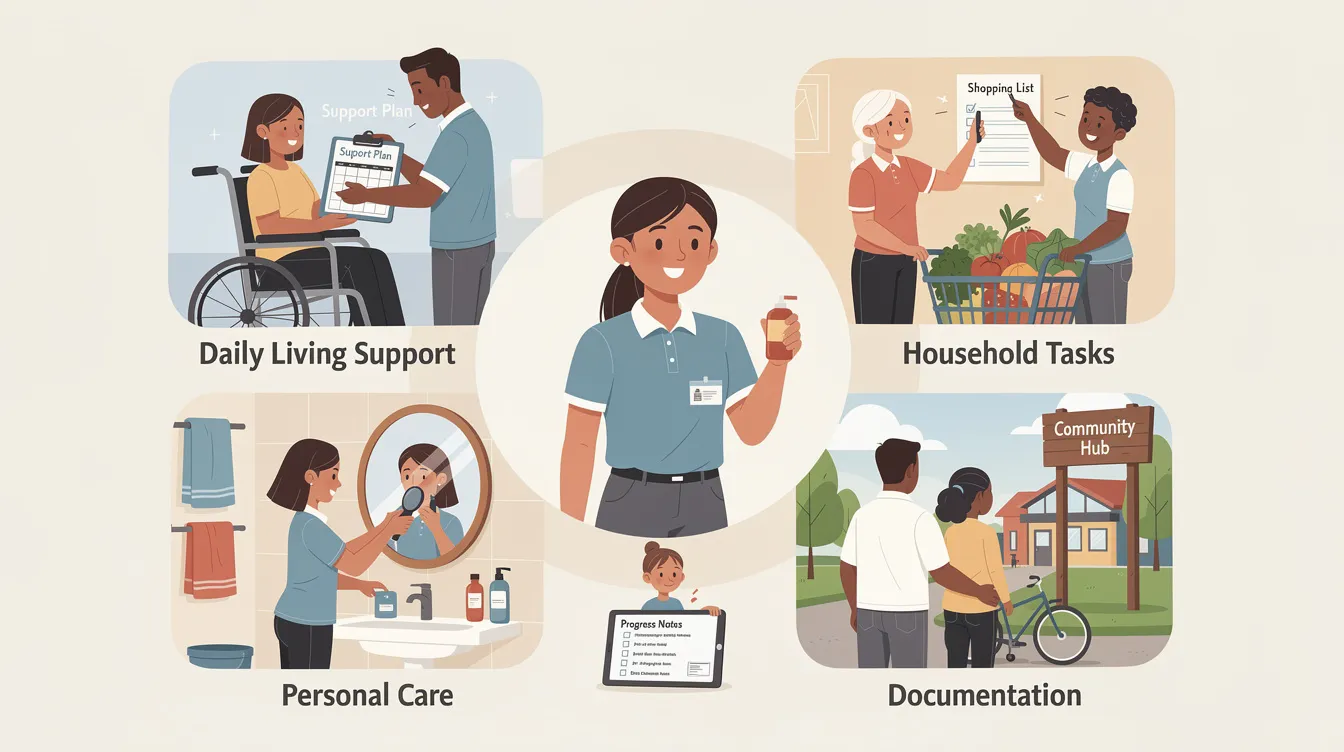
NDIS support workers help participants with daily living, community participation, emotional support, and building independence. The main aim of support work is to foster independence in participants, not to do everything for them. Support workers provide emotional support to clients with disabilities, helping them feel understood and valued. Notably, 80% of NDIS participants report more choice and control over their lives since accessing the scheme.
Core duties include:
- Assisting with everyday tasks such as meal preparation, household duties, and grocery shopping
- Providing personal care support including dressing, grooming, and hygiene
- Supporting community access, social events, and transport services
- Offering emotional support and companionship to reduce isolation
- Maintaining accurate documentation and communicating with families, support coordinators, and health professionals
Re.Connect Support Services delivers NDIS support tailored to individual goals and NDIS plans across daily activities, household support, and social and community life. A good disability support worker combines practical assistance with strong communication skills, empathy, and reliability. Duties are shaped by the participant’s NDIS plan, the NDIS Code of Conduct, and current Australian guidance. Later sections cover what workers can and cannot do, plus how to choose the right support worker in 2026.
Understanding NDIS Support Worker Duties in 2026
An NDIS support worker, also called a disability support worker, delivers services under the National Disability Insurance Scheme to assist participants with disabilities in achieving their goals and participating safely in their households and communities. NDIS disability support workers are guided by the participant’s individual NDIS plan, which outlines funded supports and specific objectives such as independent living, employment, or supported independent living in shared or individual housing.
Duties vary depending on each person’s needs, goals, and risk assessments rather than following a generic checklist, reflecting Re.Connect’s broader approach to personalised care across disability, aged care, and mental health. NDIS support workers engage in skill development and capacity building for independence, meaning their job is to help individuals with disabilities build independence over time.
Re.Connect Support Services operates within the NDIS Quality and Safeguards Commission framework, following the NDIS Code of Conduct in all service delivery while offering personalised support for individuals and families. Unlike aged care, which is typically funded under My Aged Care for older Australians, NDIS support focuses on disability-related needs regardless of age.

Core Daily Living and Household Support Duties
Much of an NDIS support worker’s day involves helping with daily living and household support. The approach is always about increasing independence, not doing everything for the person. Workers may assist with as many tasks as are outlined in the plan, including:
- Meal planning, preparing meals, and dishwashing
- Laundry, bed-making, and light cleaning
- Basic home organisation and light gardening
- Grocery shopping at stores like Coles or Woolworths
- Running errands and paying bills
Support workers help with household tasks like cleaning and cooking, and they provide personalised in-home care and domestic assistance including light housework and meal prep. They also assist with attending medical appointments, arranging transport services, and accompanying participants to GP or specialist visits.
Good practice means building new skills by “doing with, not for.” For example, a worker might support the participant to learn online grocery orders, use a weekly planner, or navigate public transport. This approach aligns with DSS guidance on promoting independence.
NDIS support workers help clients develop daily living skills such as cooking and communication, which is especially important for participants accessing specialist NDIS support for Autism Spectrum Disorder. Re.Connect workers always follow agreed support plans, safe food handling procedures, infection control, and any allied health recommendations.
Personal Care, Health, and Mental Health–Related Support
Personal care support is among the most sensitive responsibilities. It requires training, explicit consent, and deep respect for privacy and dignity. NDIS support workers maintain professional conduct and privacy in care at all times. Typical personal care duties include:
- Showering or bathing assistance
- Toileting and continence support
- Dressing and personal grooming
- General hygiene routines
- Safe manual transfers using hoists or slide sheets
NDIS support workers assist with personal care tasks like dressing and provide personal care that preserves the participant’s personal hygiene and dignity.
Health-adjacent duties include:
- Preparing healthy meals aligned with dietary needs
- Helping clients manage medication schedules and prompting necessary medication on time (but never prescribing or altering dosages)
- Monitoring for signs of illness, pressure sores, or distress
- Routine checks on wellbeing throughout each shift
Support workers also help clients manage anxiety and depression by noticing changes in mood or behaviour, offering encouragement, and supporting use of comprehensive mental health care and coping strategies suggested by qualified professionals. Mental health concerns are escalated to families or healthcare providers when appropriate.
As outlined by the NDIS Practice Standards, support workers must not carry out clinical tasks outside their competence or registration.
Emotional Support, Social Connection and Community Participation
Beyond physical tasks, a good disability support worker offers emotional support and companionship that directly affects a participant’s quality of life. Support workers provide companionship to reduce feelings of isolation, and emotional support helps clients feel understood and valued, especially when paired with specialist NDIS mental health support.
Emotional support duties include active listening, validating feelings, offering encouragement during setbacks, and helping with anxiety in public spaces or during medical appointments. Support workers help clients develop social skills and confidence over time.
Community participation tasks include many forms of community connection and engagement support:
- Supporting attendance at local community centres, TAFE, social groups, and sports
- Assisting clients in accessing community events and social activities
- Accompanying participants to social events like markets, concerts, or faith communities
- Helping with accessible transport and planning regular outings
Community engagement is a major part of NDIS goals. Support workers help with community access and transportation to appointments, and they assist clients in attending social events as part of broader mental health recovery and social participation programs. Participation in work for recipients aged 15 to 24 doubled to 22%, showing how effective structured community and employment support can be.
At Re.Connect Support Services, community support is linked clearly back to the participant’s NDIS goals, and staff document attendances and outcomes to inform plan reviews.

Documentation, Communication and Working with Families & Teams
NDIS support is highly accountable. Record keeping is an important responsibility for NDIS support workers, and accurate documentation protects both participants and workers. Key documentation duties include:
- Writing shift notes and progress updates
- Completing incident and near-miss reports
- Recording risk observations and medication charts
- Storing information securely in line with privacy requirements
Workers communicate important information to support coordinators, therapists, and Re.Connect case managers. Where consent is given, they also update family or informal supports. Collaboration with allied health professionals means following OT or physiotherapy plans, implementing behaviour support strategies, and giving honest feedback to clinicians about what is and isn’t working in the home environment.
Re.Connect trains staff in respectful communication, privacy, confidentiality, and informed consent, which aligns closely with our specialist NDIS support coordination services.
What Makes a Good Disability Support Worker?
There is a clear difference between meeting minimum duties and being an excellent support worker. The qualities that set great workers apart go beyond supporting clients through routine tasks. Core professional qualities include:
- Reliability, punctuality, and strong organisational skills
- Ability to manage varied tasks without losing focus on the participant’s goals
- Patience, which is a crucial quality for disability support workers
Interpersonal skills matter just as much: clear communication skills, empathy, cultural sensitivity, and non-judgemental attitudes, which are the same qualities we seek in disability support worker job applicants. Empathy and communication skills are essential for support workers, especially when working with people from diverse backgrounds or those with complex communication needs.
A Certificate III in Individual Support is required as a baseline qualification, though qualifications can range from certificates to university degrees depending on the role, especially when helping participants use their NDIS Core Supports for daily living and participation. NDIS support workers must complete an NDIS Worker Screening Check before commencing work. Commitment to continuous learning, including refresher training in first aid, manual handling, and mental health first aid, is what keeps workers effective and safe and underpins our healing and recovery-focused support services.

Limits, Boundaries, and Safety: What NDIS Support Workers Cannot Do
Understanding what is out of scope is just as important as knowing the duties, for both participant safety and legal compliance. Tasks outside a standard support worker’s scope include:
- Complex nursing procedures such as IV medications or injections
- Clinical decision-making, prescribing, or changing medications
- Providing legal or financial advice
- Any activity that breaches workplace health and safety rules
Support workers cannot enter romantic relationships with participants, borrow money, manage a participant’s personal finances for their own benefit, or make major decisions on behalf of the person except where formally authorised through guardianship arrangements.
Workers must refuse unsafe tasks, such as heavy lifting beyond their training, and report concerns immediately to their provider or the NDIS Commission if there is risk of abuse, neglect, or exploitation. Participants should always feel empowered to speak up if something feels wrong.
How Re.Connect Support Services Supports Participants and Workers
Re.Connect Support Services is a participant-centred NDIS provider focused on safe, flexible, and personalised care support across daily living, household assistance, and community participation, delivering NDIS-registered personalised support services. 80% of NDIS participants report more choice and control in life, and Re.Connect works to make that a reality for every person we support.
Re.Connect matches NDIS participants with disability support workers based on skills, interests, cultural fit, language, and location, reviewing this regularly to ensure a strong working relationship and to uphold our mission of empowering individuals to reclaim their lives. Service agreements clearly outline duties, and regular check-ins, feedback channels, and transparent complaint procedures keep both participants and staff safe.
We encourage participants to discuss their goals before support starts, keep communication open, and request adjustments if duties are no longer meeting their individual needs, and our resources in the Re.Connect Support Services blog can help participants prepare for these conversations.
Frequently Asked Questions
Do NDIS support worker duties differ between disability and aged care?
Many core tasks like personal care, household support, and emotional support are similar across disability and aged care settings. However, NDIS support focuses specifically on disability-related needs and goals regardless of age, while aged care is usually funded under My Aged Care for eligible older Australians, and some people also access specialist guidance on choosing the right support coordinator.
Can my NDIS support worker handle my money or pay my bills?
Support workers can assist with practical tasks like setting up online banking, using budgeting tools, or accompanying you to pay bills, which is particularly important for people also engaging with holistic homelessness and housing support services. They should not control your money, use your bank card or PIN, or make financial decisions for you unless there is a formal arrangement with clear safeguards in place.
How many hours per week can an NDIS support worker assist me?
The number of hours is determined by your individual NDIS plan, your budget categories, and what has been approved by the NDIA. If your current hours are not enough, review your plan with a support coordinator who can help you navigate the NDIS or planner. Re.Connect can provide documentation about current support usage to assist with plan reassessments, and participants may also benefit from expert support coordination to maximise NDIS funding.
What qualifications should a good disability support worker have?
At minimum, a Certificate III in Individual Support (Disability), an NDIS Worker Screening Check, and current First Aid and CPR certification. Role-specific training in areas like mental health, behaviour support, or manual handling adds further capability.
How can I give feedback or make a complaint about my support worker?
You can raise concerns directly with your support worker, or contact Re.Connect Support Services via phone, email, or an internal feedback form. If you are not satisfied with the response or feel unsafe, you can contact the NDIS Quality and Safeguards Commission directly.