
Your NDIS plan review is one of the most important moments in your NDIS journey. It determines what funding and supports you receive for the next plan period, and getting it right can make a real difference to your daily life. This guide walks you through a step-by-step plan review checklist so you can feel empowered, organised, and ready.
Key Takeaways
- An ndis plan review checks whether your current ndis plan, goals, and disability support still match your life in 2026.
- Start preparing 6–12 weeks before your review: review your current plan, set new goals, gather reports, and organise a support person.
- Every request for additional support (extra therapy, more community participation hours, assistive technology) must be backed by the right evidence and linked to a specific NDIS goal.
- Preparation for an NDIS plan review involves gathering evidence of needs and reviewing goals, including evaluating current goals and budget.
- You can bring a family member, carer, support coordinator, or advocate to your meeting, and you can challenge decisions through an internal review if you disagree with the outcome.
What Is an NDIS Plan Review in 2026?
An ndis plan review (now more commonly called a plan reassessment by the National Disability Insurance Agency) is when the NDIA or your local area coordinator looks at whether your current ndis plan still meets your disability support needs, goals, and circumstances. It ensures that your funded supports remain “reasonable and necessary” for achieving outcomes like community participation, independent living, or improved well being.
A plan review can adjust your funded supports-increase, decrease, or reallocate across funding categories-but it is not simply about asking for more money. It is about demonstrating need through evidence and linking every request to clear goals. Participants can also have check-ins or plan variations depending on their situation.
In 2026, most plans are reviewed every 12 to 24 months, though children or people with rapidly changing needs may have shorter cycles. The NDIS emphasizes connecting funding requests to specific goals from 2026 onwards, making preparation more important than ever.
Types of NDIS Plan Reviews (Scheduled, Early, and Light-Touch)
Depending on what has changed in your life, you may encounter different types of reviews during your plan period.
Scheduled reviews occur near the end date of your approved plan. Your local area coordinator or NDIA planner typically contacts you 8–12 weeks beforehand to start the plan review process.
Participant requested reviews (early reviews) can be triggered when your circumstances change significantly-a new diagnosis, loss of informal supports from a family member, hospitalisation, or a move to a new living situation. You can request a participant-initiated review at any time by calling 1800 800 110, using the my NDIS portal, or speaking with your support coordinator.
Light-touch reviews handle minor updates, like shifting budget between Core and Capacity Building, or extending a stable plan. For example, if you need more funding for transport but your current supports are otherwise working well, a light-touch review process may be appropriate.
Real examples: a main carer becomes unwell and can no longer provide daily personal care, triggering an early review. Or your community access transport budget runs short while everything else is fine, handled through a light-touch variation.
Always document the date you request a review and keep a copy of any correspondence.

Step 1: Review Your Current NDIS Plan and Spending
Every good ndis plan review starts with understanding what happened in your last plan-what worked, what didn’t, and how funds were used.
Download or view your current plan via the myplace portal or my NDIS app, or request a hard copy. Then go through each budget area:
- Core – daily living, social and community participation, transport, consumables under your NDIS Core Supports Budget
- Capacity Building – therapies, support coordination services, employment support
- Capital – assistive technology and home modifications
For each area, note:
| Question | Your Notes |
|---|---|
| Which supports did I use regularly? | |
| Which supports were hard to access (waitlists, workforce shortages)? | |
| What funding went unspent, and why? | |
| Check statements from your plan manager or provider invoices to see which line items and support hours were actually used. Tracking spending during the plan review helps identify overspending categories and gaps and is a key part of effective NDIS plan management. Underspending must be explained during your review-common reasons include provider cancellations, hospital stays, or difficulty finding suitable support workers. |
Create a simple “keep, change, stop” list for each major support. This practical tips approach helps you identify areas that need adjustment before you walk into the meeting.
Step 2: Reflect on Changes in Your Life and Daily Functioning
This step is about honest reflection on how your life has changed since your last plan. The NDIA recommends preparing by identifying any changes in circumstances before the NDIS check-in.
Ask yourself these questions:
- Has my health, mobility, or mental health changed?
- Has a family member who helped me moved away or started work?
- Have I started or stopped study, employment or work-related activities supported by the NDIS, or community activities?
- Can I manage personal care tasks independently, or do I need more help?
Focus on functional impact rather than diagnosis alone. What can you do, what takes longer, and what happens without support? Participants should prepare a statement of daily challenges for their review-specific examples carry far more weight than general descriptions.
Create a simple daily support summary noting times of day (morning routine, meals, evening) and the exact help required. Capture both improvements (new skills, increased independence) and setbacks (deterioration in mobility, more frequent meltdowns or panic attacks).
Use specific examples: “I missed three medical appointments this year because I didn’t have support to get there” is far more persuasive than “I need more transport,” and can support requests for NDIS travel and transport funding. Documenting any life changes is necessary for your plan review, and you should prepare a clear summary of daily support needs for the review meeting.

Step 3: Update Your NDIS Goals and Community Participation Plans
Your goals give your NDIS plan purpose and direction. NDIS funding is directly linked to them, so they must reflect what you want to achieve over the next 12–24 months. Clear goals guide your ndis plan review process and should be updated if your needs change.
Common goal areas include, and can be strengthened by focusing on Improved Life Choices within your NDIS plan:
- Daily living and personal care
- Social and community participation through NDIS Core Supports
- Employment or study
- Health, nutrition, and overall well being
- Relationships and building independence through Supported Independent Living
Include a mix of short-term and longer-term goals. For example:
- Short-term: “I want to improve my balance so I can walk safely at home” → linked to physiotherapy
- Long-term: “I want to build confidence to attend a local art group independently” → linked to community access support
Turn vague goals into specific ones tied to requested supports. Every new support you request should clearly connect to at least one written goal in the new plan. Connect every support request to your specific NDIS goals-this is the foundation of a strong review.
Involve a family member, carer, or therapist in refining your current ndis goals so they are realistic, meaningful, and achievable. A clear list of current goals should be maintained for effective NDIS reviews, and your NDIS plan should reflect your current goals. Participants should also define their future support needs for new goals.
Step 4: Gather Your Evidence, Reports, and Carer Statement
Strong, up-to-date evidence is often the difference between adequate and insufficient ndis funding at review. A comprehensive report from a key allied health professional is crucial to your outcome.
Gather up-to-date reports from your therapists before the review. Types of evidence to collect:
- Occupational therapy functional assessments
- Physiotherapy and speech pathology reports
- Psychology or mental health plans
- Behaviour support plans
- GP or specialist letters
- School or workplace reports
- New assistive technology quotes and recommendations
Include therapy reports, GP letters, and support worker notes. Reports should describe functional impact-what you can do, where you need support, and how often-not just list diagnoses. Evidence should link support to specific disability needs, and evidence should connect supports directly to goals during a review.
What is a carer statement? A brief written overview from a parent, partner, or other family member describing how they support you, the impact on their own well being, and what would happen if they could not continue. Include specific examples: hours per week spent providing support, overnight supervision, help with emotional regulation, and how the carer’s own employment or health is affected.
Book allied health professionals for re-assessment appointments about 8–10 weeks before your review. Many providers need 4–6 weeks to write thorough reports, so delays mean key evidence may be missing.
Step 5: Organise Your NDIS Plan Review Checklist and Support Team
Now it is time to turn all your earlier work into a clear, easy-to-use bundle. Start preparing documents 6–8 weeks before your review meeting so nothing is rushed, and think about how managing your NDIS funding effectively will support the goals in your new plan.
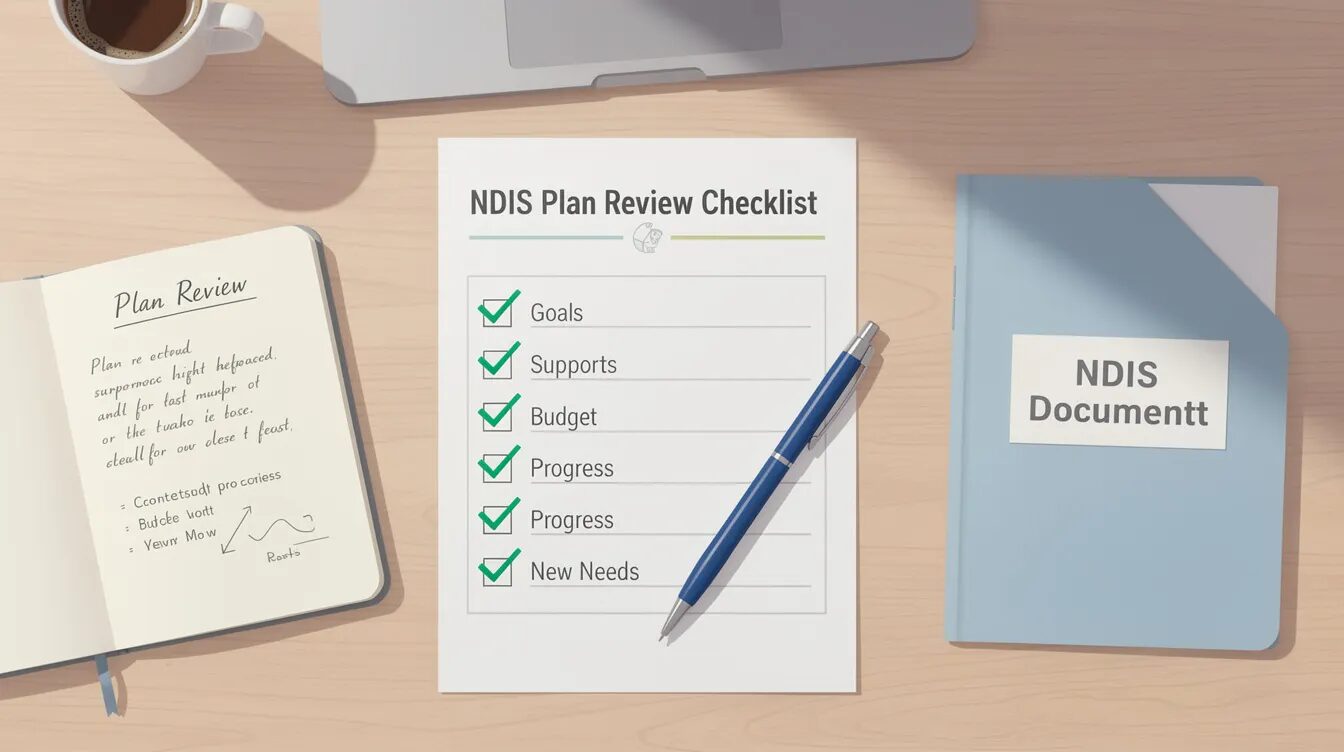
Create a simple plan review checklist document (digital or paper) with these sections:
- Personal details and plan dates
- Summary of current plan and spending
- List of changes in your life
- Updated goals (short-term and long-term)
- Requested supports with evidence attached
- Progress notes and goal tracking
- Questions for the ndia planner
Keep all documents in one labelled folder: your current plan, provider reports, carer statement, spending summaries, daily support summary, and any letters from schools, employers, or housing providers.
Choose who will attend your plan review meeting. Options include a family member, close friend, support coordinator to help you maximise funding, recovery coach, or independent advocate. A support person can be beneficial during the NDIS review meeting-they can help you stay on track and remember key points.
Give your support team a copy of the checklist beforehand. Practise key messages out loud so you can feel confident and avoid forgetting important information on the day. Tracking goal progress is important when preparing, and participants are advised to prepare questions to ask during the meeting.

Step 6: What to Expect in Your NDIS Plan Review Meeting
Your ndis plan review meeting is typically a phone, video, or face-to-face conversation with an NDIA planner, local area coordinator, or Early Childhood partner. An NDIS plan review meeting typically lasts 60 to 90 minutes, so plan your time accordingly.
The usual flow looks like this:
- Introductions and confirmation of details
- Discussion of your current supports and what worked
- Review of your goals and progress
- Conversation about what has changed in your daily life
- Discussion of what is needed for the next plan period
Speak slowly, use concrete examples, and refer to your daily support summary. For each major support you want, clearly explain three things:
- The need: what is hard or what your daily challenges are
- The impact without support: what goes wrong
- The goal link: how the support will help you achieve a specific goal
You have the right to ask questions if you do not understand decisions, and to ask the planner to repeat or summarise what has been agreed. You can bring a family member or advocate to speak or take notes. It is perfectly okay to say “I’m not sure, can I think about that?” if a decision feels rushed.
Prepare a clear summary of your daily support needs for the review and connect every support request to your specific goals.
After the Review: Checking Your New Plan and Next Steps
After the meeting, the NDIA sends your new plan within 21 days. You will receive it via the myplace portal, my NDIS app, or post.
When your new plan arrives, carefully check:
- Goals are correct and match what was discussed
- Funding amounts reflect agreed levels across all funding categories
- Key supports (support coordination, community access, therapies, assistive technology, home modifications) are included at realistic levels
- Certain supports you specifically discussed are not missing
Compare your own meeting notes and review checklist with the final plan. Highlight any differences, errors, or missing items.
If something is clearly wrong-a therapy budget missing after being agreed, or unexplained cuts to increased support hours-contact your ndia planner, local area coordinator, or my NDIS contact straight away. If the issue is not resolved, you can request an internal review within three months of the written decision. You can escalate disagreements to the Administrative Appeals Tribunal if the internal review does not resolve matters.
Concrete next steps for your next plan:
- Book a plan implementation meeting with your support coordinator
- Update service agreements with providers
- Adjust rosters to match new budgets for support workers
- Use the my NDIS portal to track spending from day one
Practical Resources, Websites, and Advocacy Support for Your NDIS Journey
Here is a curated list of trusted Australian resources to help you prepare for your plan review, get independent advice, or lodge concerns, alongside broader Australian disability services and accessibility supports.
| Resource | Website | What It Helps With |
|---|---|---|
| NDIS Official | ndis.gov.au | Plan reassessment guides, downloadable booklets, check-in preparation |
| Disability Gateway | disabilitygateway.gov.au | Find local advocates through the Disability Advocacy Finder |
| Carers Australia | carersaustralia.com.au | Carer statement guides, carer support services |
| NDIS Commission | ndiscommission.gov.au | Provider complaints, quality and safety concerns |
| Use these sites and other NDIS and disability support blogs and resources to download templates for daily support summaries, carer statements, and goal-setting sheets to strengthen your ndis plan review checklist. |
Keep a list of important contacts-your support coordinator, main providers, GP, key therapists, local Centres for Independent Living and peer support services, and my NDIS contact-with phone numbers and emails. This lets you quickly request new evidence or follow up on decisions.
Subscribe to NDIS email updates or check the website each quarter to stay informed about NDIS policy changes and scheme updates, new forms, or terminology updates that may affect your next plan period.

FAQ: NDIS Plan Review Checklist and Best Practices
This FAQ covers common questions not fully addressed in the main checklist, focusing on practical issues around timing, evidence, and support people.
How early should I start preparing for my NDIS plan review?
Start light preparation about 3 months before your expected review date-reflecting on goals, noting what has changed, and identifying areas for improvement. Move into more active work 6–8 weeks prior: booking assessments, gathering reports from allied health professionals, and drafting your carer statement. Some providers need 4–6 weeks to write comprehensive reports, so delays in booking can mean critical evidence is missing. Set calendar reminders when you first receive your current plan so the review does not catch you by surprise.
What if I haven’t used all my funding in my current plan?
Underspend does not automatically mean your current funding will be cut, but the NDIA will want to understand why funds were not fully used. Acceptable reasons include provider shortages, long waiting lists, illness, hospital stays, or difficulty finding suitable support workers. Bring written notes or provider letters explaining these reasons, and clearly state if you still need the same or higher level of support going forward. Many participants face workforce challenges that have nothing to do with their actual support needs.
Can I change my providers after my NDIS plan review?
Once a new ndis plan is approved, you remain free to change most providers at any time, as long as you follow notice periods in your service agreements. Reviews are a useful time to think about which providers are working well and which are not, and to seek recommendations for new services that better support goals like community participation or build independence, especially if you are also considering aged care options alongside NDIS supports. Check provider directories, online reviews, and word-of-mouth recommendations, and ensure new providers understand NDIS price limits, particularly if you or your family member needs specialist NDIS support for Autism Spectrum Disorder.
Do I have to write a carer statement if I already have reports?
A carer statement is not mandatory but strongly recommended because it captures the day-to-day reality that may not appear in clinical reports. NDIA planners often use carer statements to understand unpaid support hours, the impact on a family member’s employment and health, and the risks if that informal support reduces. Keep it to one or two pages, focused on specific daily tasks, overnight supervision, and how the carer’s own life is affected.
What can I do if I feel overwhelmed or anxious about my review?
It is completely normal if the process can feel overwhelming. Ask a trusted family member, friend, support coordinator, or advocate to help prepare and attend the meeting. Break preparation into small tasks over several weeks and use written notes so you do not have to remember everything on the spot. You can request reasonable adjustments from the NDIA, such as longer appointments, breaks, or a preferred contact method. Reach out to mental health professionals or peer support groups if anxiety is severe, and remember you are allowed to ask for time to think before agreeing to major changes.