Understanding about NDIS eligibility criteria is knowing whether you or someone you care about can access the national disability insurance scheme starts with knowing the eligibility criteria. This guide is for Australians with disability, their families, and carers seeking to understand NDIS access. The rules are straightforward once you break them down, but getting the detail right can make or break an application. This guide walks you through every requirement, what evidence you need, and what to do if you’re not eligible.
Key Takeaways
- NDIS eligibility is based on three criteria: age, residency, and the impact of a permanent impairment on daily life and social participation. You must generally be under 65, live in Australia, and be an Australian citizen, permanent resident, or protected special category visa holder.
- Eligibility is not means-tested. Income, savings, or Centrelink payments do not affect whether you may be eligible. What matters is how a disability caused by a permanent impairment affects functional capacity and future need for support.
- Children younger than 9 usually start with the early childhood approach rather than a standard NDIS plan, especially where there is developmental delay or a diagnosed disability.
- Strong medical and functional evidence from health professionals is critical to a successful NDIS application.
- People who are not eligible for the NDIS can still receive support through mainstream and community disability services.
What Is the NDIS and Why Eligibility Matters
The national disability insurance scheme NDIS is an Australian government program that funds reasonable and necessary disability support for people with a permanent and significant disability. It is not a general welfare payment – it is a support insurance scheme designed to provide greater independence and participation.
The scheme is administered by the National Disability Insurance Agency (NDIA), and only people who meet specific eligibility requirements can become an NDIS participant. Eligibility rules exist so that NDIS funding can focus on those with long-term functional impact who need ongoing support over and above what mainstream supports like health, education, and aged care would normally provide.
Many Australians with disability receive support through other systems even if they do not meet NDIS access requirements. The NDIS is one part of a broader network of services, and when people do become participants they may tap into budgets like Improved Life Choices to manage and direct their supports.
Core NDIS Eligibility Requirements
Eligibility for the NDIS requires age, residency, and disability criteria.
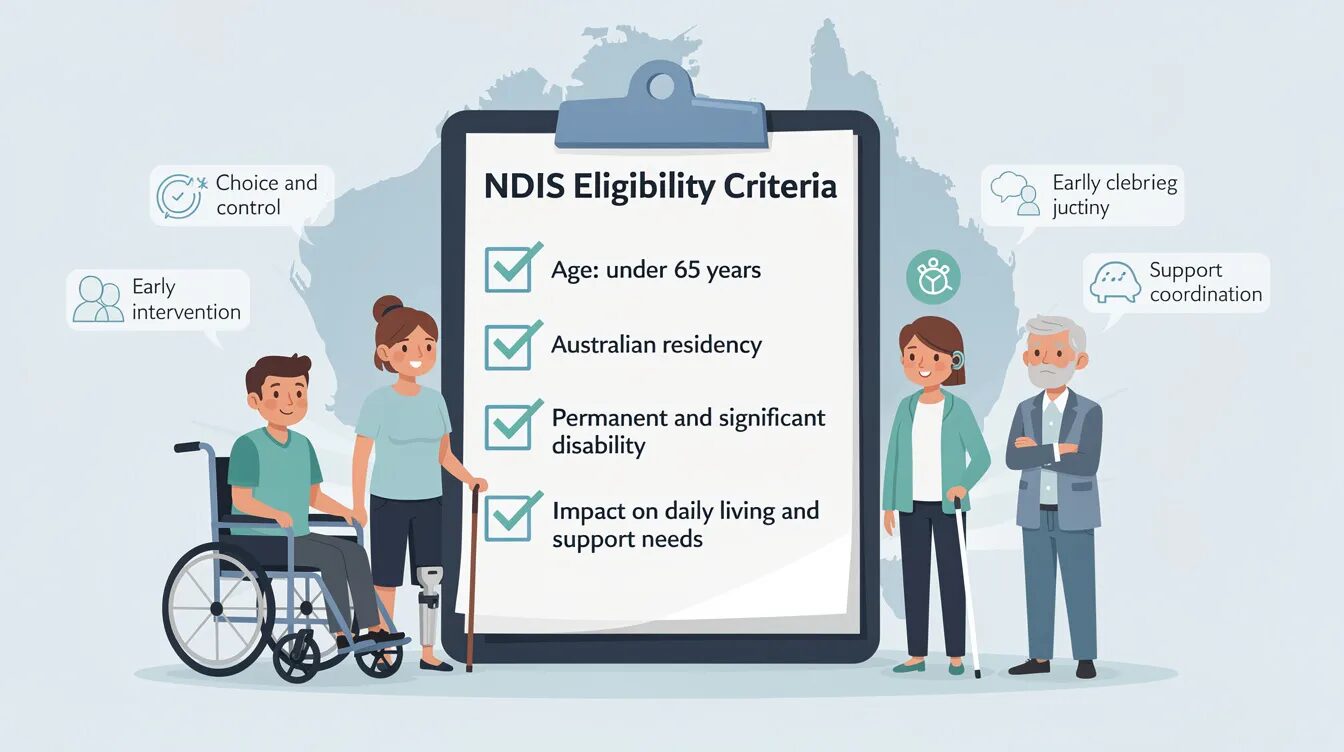
Eligibility for the NDIS requires meeting three core criteria: age, residency, and disability or early intervention requirements. All three must be satisfied on the day the NDIA receives your complete access request.
There is no income test. NDIS is not means-tested; income does not affect eligibility. Salary, savings, or Centrelink payments like the Disability Support Pension have no bearing on your application process. However, compensation payouts from insurance or court settlements can interact with how much funding the NDIS provides in certain cases.
The sections below unpack what permanent impairment, functional impact, and future need mean in practical terms for daily life.
Age Requirements for NDIS Eligibility
Age is checked first. You must be under 65 to apply for NDIS – specifically, under 65 years old on the day the NDIA receives your valid NDIS access request. Applications must be submitted before you turn 65 years old. For example, if your application is received on 10 March 2026 and your 65th birthday is 11 March 2026, you satisfy the age requirement.
You must be aged between 7 and 64 years old to apply for the NDIS through the standard pathway. Individuals aged 65 or older cannot apply for NDIS and are generally directed to My Aged Care. Most new participants sit within this age bracket.
Children and the Early Childhood Approach
Children under 9 can access support through the early childhood approach, which is led by an early childhood partner in the local community. Since July 2023, children under 6 with developmental delay, or under 9 with a diagnosed disability, can receive early childhood supports before becoming full NDIS participants.
Children under 7 years may be eligible under early intervention requirements even without a formal diagnosis. Early childhood partners assess the child’s functional impact in daily life – play, communication, mobility, self care – and may recommend short-term early intervention supports, connections to mainstream supports, or an NDIS plan if needs are significant. Over 70,000 children and families have benefited from supports delivered through this approach nationally.
If you are concerned about a child’s development, contact a local area coordinator or early childhood partner. A child representative such as a parent or guardian can start this process.

Residency and Living in Australia
Both your residency status and where you usually live are checked as part of NDIS eligibility. You must currently reside in Australia to be eligible for the NDIS, and you must live in Australia and spend most of your time here – essentially, Australia must be your home.
Eligible visa types include:
- Australian citizen (including an Australian citizen living overseas who returns)
- Permanent resident or permanent residency visa holder (permanent visa holders)
- Special category visa holder who holds a protected special category visa (New Zealand citizens meeting specific criteria)
You need to provide evidence of your residency status. Proof such as a passport, visa grant notice, or other identity documents is required. NDIS eligibility requires residency verification through Centrelink or the Department of Home Affairs, and you may be asked to give consent for the NDIA to confirm your details.
Disability Requirements: Permanent Impairment and Functional Impact
NDIS eligibility assesses how a disability impacts daily functioning rather than just diagnoses. The NDIA does not simply check a list of diagnoses. You must have a permanent disability impacting daily activities, and some people with very high support needs may also require Specialist Disability Accommodation under the NDIS.
Disability requirements can be met either through the permanent disability rules or via early intervention requirements, and sometimes both pathways apply at once.
What is an Impairment?
An impairment is a significant loss or change in body function or structure.
Types of Eligible Disabilities
Eligible disabilities include intellectual, cognitive, and physical impairments, as well as neurological, sensory, and psychosocial disability. The NDIS does not focus on what caused the impairment – whether it was an injury, genetic condition, illness, or mental health condition. What matters is the disability that results.
Evidence Requirements
Applicants must provide evidence from doctors and a treating professional showing how the impairment leads to disability in daily life. Examples include spinal cord injury leading to mobility impairment, autism spectrum disorder affecting communication and social interaction, or schizophrenia affecting cognitive and psychosocial functioning, where assistive technology funded by the NDIS can play a key role in everyday independence.
Impairment Is Likely to Be Permanent
For NDIS purposes, a condition must be likely to be permanent – lifelong – even if symptoms fluctuate or are episodic. The NDIA considers whether all reasonable treatments and rehabilitation options have been tried, or are unlikely to substantially reduce the impairment.
Medical reports must state the condition is likely to be permanent, not just “long-term” or “chronic.” Some conditions on NDIS “List A” are usually accepted as permanent and significantly disabling, while others listed elsewhere require more detailed functional evidence. The right evidence makes or breaks this step.
Functional Impact Domains
Beyond permanence, the impairment must substantially reduce functional capacity to complete daily life activities. The NDIA assesses these key domains:
- Communication – expressing needs, understanding others
- Social interaction – maintaining relationships, participating in groups
- Learning – acquiring new skills relative to age
- Mobility – moving around home and community safely
- Self care – showering, dressing, eating independently
- Self-management – organising routines, managing finances, following schedules
For example, needing daily assistance with showering and dressing, being unable to use public transport independently, or requiring constant prompting for everyday tasks due to cognitive difficulties all demonstrate substantial functional impact and are common reasons people seek disability services that promote independence and inclusion.
Evidence must describe the functional impact in detail. An allied health professional – such as an OT, physiotherapist, psychologist, or speech pathologist – is often essential for this.
Impact on Work, Study and Social Life
The NDIA also considers how a permanent impairment limits participation in work, education, parenting, and social life. Examples include difficulty sustaining employment, needing support to attend TAFE or university, or being unable to join community groups without assistance, which are all areas where capacity building in individuals and communities can make a significant difference.
A young adult with psychosocial disability, for instance, may need support to manage their daily routine, attend appointments, and engage safely in community activities, including help to build skills and confidence for NDIS-supported employment opportunities. NDIS funding aims to offer services and provide support that enable more independent participation over time.
Need for Ongoing, Lifetime NDIS Support
The NDIA must be satisfied that you are likely to need disability-specific support for your lifetime, even if the level changes. Permanent disabilities must significantly impact daily activities, and those disabilities must require ongoing support for daily living.
NDIS supports focus on what is reasonable and necessary – over and above what family members, schools, health services, and community programs would normally provide, with many participants also accessing capacity building supports that improve independence and participation. Early intervention supports may be funded where acting now is likely to reduce your future need for higher-level support.
Early Intervention and the NDIS Early Childhood Approach
Early intervention under the NDIS means putting supports in place early to reduce the future impact of disability or impairment. A person can be found eligible under early intervention requirements even if it is not yet clear they will always need lifetime support – particularly for younger children or progressive conditions.
The early childhood approach for children under 9 focuses on quick access to early intervention supports, family-centred practice, and practical strategies for home, childcare, and school. For example, a child aged 3 with speech delay may receive NDIS-funded speech therapy that improves developmental outcomes and reduces the need for more intensive supports later, while children on the autism spectrum may benefit from specialist NDIS support for Autism Spectrum Disorder.
Evidence You Need to Prove NDIS Eligibility
Identity Documents
Gathering the right evidence is one of the most important steps on your NDIS journey. You need three identity documents to apply for NDIS.
Medical and Functional Evidence
You also need to gather supporting evidence from your health professionals for your application, and some participants will later use specialist support coordination to manage complex supports and funding.
Typical evidence includes, and many people find it helpful to work with NDIS support coordinators to gather the right reports:
- GP reports and specialist letters
- Allied health assessments (OT, speech, psychology)
- Hospital discharge summaries
- Functional capacity reports
Documents should be recent, clearly describe permanent impairment, functional impact in daily life, and future need for disability-specific support. The NDIA has specific forms – such as the Evidence of Disability and Functional Impact forms – that help a treating professional provide the right level of detail, including when you are accessing assistive technology through the NDIS.
Describing Functional Impact in Daily Life
Use real-life examples rather than vague terms. “Needs help to shower safely most days” is far stronger than “has some difficulty with self care.” Carers, support workers, and family members can help describe the person’s typical week, including supports already provided informally.
For psychosocial disability, evidence should cover how symptoms affect motivation, concentration, emotional regulation, and ability to manage daily tasks or social situations. The NDIA may request additional information if the first set of evidence is incomplete.

How to Check Your NDIS Eligibility and Apply
Start by using the NDIS eligibility checklist online or speaking with a local area coordinator or early childhood partner. You can apply for NDIS by calling 1800 800 110.
The application process involves:
- Requesting an access request form from the NDIA, a local area coordinator, or an early childhood partner.
- Completing sections on age, residency, disability, early intervention, and current supports.
- Having sections completed by treating professionals (GP, specialist, allied health professional).
- Submitting a completed access request form with supporting evidence.
You will receive a written decision. If you are found not eligible, the NDIA will outline the reasons.
What Happens If You Are Found Eligible
Once eligible for the NDIS, the NDIA or a partner contacts you to book a planning meeting. This meeting explores your daily life, goals, current informal supports, and the disability-specific NDIS supports that may be reasonable and necessary, including whether you need support coordination to help implement your plan.
The outcome is an individual NDIS plan with NDIS funding categories and budgets tailored to your functional needs and goals, often including a Core Supports Budget for everyday assistance and participation. Plans are reviewed regularly, especially when circumstances change or for children as they grow.
What If You Are Not Eligible for the NDIS
People who are not eligible can still access the NDIS to receive support through mainstream services – Medicare-funded health care, public hospitals, education supports, mental health services, and community programs. A local area coordinator can help you find other supports, including state and territory disability services and carer supports, and once you do access the scheme it is important to follow practical tips for managing your NDIS funding effectively.
If you believe the NDIA made an error, you can request an internal review of the decision within the relevant timeframe, and then appeal to the Administrative Appeals Tribunal if needed. Eligibility can sometimes change if a person’s condition progresses or new evidence becomes available, and you may find it useful to read NDIS and disability support articles on our blog for further guidance.
Common Misunderstandings About NDIS Eligibility

- The NDIS is means-tested. It is not. Income, savings, and Centrelink payments do not affect eligibility.
- A diagnosis guarantees eligibility. A diagnosis alone – such as ADHD, anxiety, or mild back pain – does not guarantee access. The NDIA focuses on functional impact and permanent impairment.
- People over 65 can never access the NDIS. If your access request was submitted before you turned 65, you may still be found eligible.
- NDIS pays for rent and everyday costs. NDIS funding is not designed to replace income, pay rent, or cover everyday living costs unrelated to disability. It funds the right support that arises specifically because of disability.
- If you’re not eligible, there’s no help. Many people with disability who do not meet NDIS criteria can still access significant assistance through health, aged care, and community disability services.
Frequently Asked Questions About NDIS Eligibility
Can I get NDIS and Centrelink at the same time?
Yes. Many NDIS participants also receive Centrelink payments such as Disability Support Pension, JobSeeker, or Carer Payment. The two systems are separate, and most Centrelink payments are not reduced because you start receiving NDIS funding. However, some allowances like Mobility Allowance may stop if the NDIS funds similar transport supports. Check specific interactions with Services Australia for up-to-date advice and consider how different NDIS plan management options affect your finances.
Does a mental health condition (psychosocial disability) qualify for the NDIS?
A mental health condition can meet NDIS criteria where it causes a permanent impairment and substantial functional impact on daily life and social life. The NDIA looks for evidence that symptoms are likely to be permanent, that all reasonable treatments have been tried, and that ongoing psychosocial support is needed. Many people with mental health conditions will instead receive support through mainstream mental health services if they do not meet the disability requirements.
Is ADHD or a learning difficulty on its own enough for NDIS eligibility?
ADHD or specific learning difficulties alone will only rarely meet NDIS eligibility thresholds. To qualify, there must be clear evidence of permanent impairment with severe functional impact across multiple life domains – such as communication, learning, and self-management – often in combination with other diagnoses. Families should discuss concerns with their GP, paediatrician, or psychologist, who can advise whether the child’s support needs may meet NDIS criteria or are better supported through schools and mainstream supports.
Do I need a diagnosis before I can apply for the NDIS?
In most cases,
Can I use NDIS funding if I travel or move interstate?
The NDIS is a national disability insurance scheme, so participants can continue to use their NDIS funding if they move within Australia. You should update your address with the NDIA, and your supports may change depending on location. Short trips overseas may be allowed for limited periods, but long-term overseas stays can affect eligibility and how much funding remains available. Speak with the NDIA or a support coordinator before extended travel to understand current policies and any impact on your plan.