
If you or someone you care about lives with a serious mental health condition, the process of finding long-term support can feel confusing. The good news is that NDIS mental health support exists specifically for people whose condition makes daily life significantly harder – and you don’t need to navigate the system alone. This guide walks you through how to apply for NDIS mental health support, what evidence you need, and how Re.Connect Support Services can help at every stage.
Key Takeaways
- People with significant, long-term mental health conditions – known as psychosocial disability – may be eligible for NDIS funding to support daily living, recovery goals, and community participation.
- The four core steps to apply for NDIS mental health support are: check the eligibility criteria, gather strong evidence, submit an Access Request, and attend a planning meeting.
- Re.Connect Support Services can help at each stage of your NDIS journey, from preparing evidence to putting core supports and capacity building supports in place.
- Applicants can get free initial guidance from a local area coordinator or NDIA partner in the community.
- You do not need to have everything “sorted” before contacting Re.Connect – support can start early, even before you know if you qualify.
Understanding NDIS Mental Health (Psychosocial Disability)
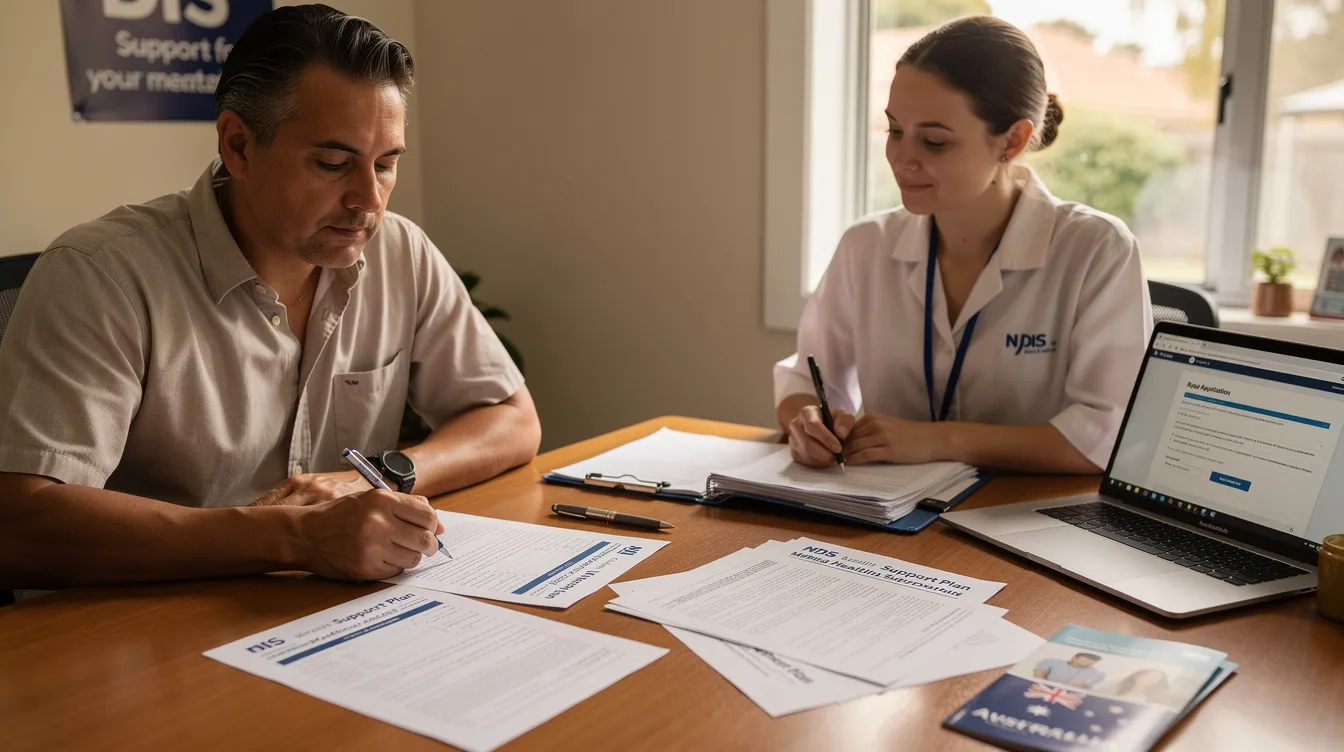
Psychosocial disability refers to the functional impact that mental health conditions – such as schizophrenia, bipolar disorder, severe depression, PTSD, or borderline personality disorder – have on a person’s ability to carry out everyday activities. It is not about the diagnosis name. It is about how the condition affects daily life and participation over time.
The National Disability Insurance Scheme (NDIS) supports individuals with psychosocial disabilities to improve daily functioning. This means the NDIS focuses on disability-related functional support rather than just clinical treatment. Clinical treatment like medication, hospital stays, and psychiatrist appointments remains the responsibility of Australia’s health system. The NDIS funds non-clinical supports – things that help with independence, building skills, routines, and community participation.
Importantly, NDIS applications for psychosocial disability focus on functional impacts, not just diagnoses. Someone whose mental health fluctuates can still qualify, as long as the overall impact is significant and long-term.

Am I Eligible? NDIS Mental Health Eligibility Criteria
NDIS eligibility is assessed based on functional capacity, alongside age, residency, and the permanency of your condition. Here are the baseline requirements:
- Age: Participants must be aged between 7 and 65 years old at the time of the access request.
- Residency: Applicants must be an Australian citizen, permanent resident, or hold a Protected Special Category Visa. This is a non-negotiable requirement under the disability insurance scheme NDIS rules.
For mental health conditions specifically, the NDIS assesses applications based on significant reduction in functional capacity across life areas. Your condition must be:
- Diagnosed by a qualified mental health professional
- Ongoing and not likely to improve, even with appropriate clinical treatment (conditions must be lasting – generally 2+ years)
- Causing a substantial impact on at least one of the six NDIS life domains: communication, social interaction, learning, mobility, self-care, and self-management
A mental health condition must significantly impact daily life for the person to meet the threshold for a permanent and significant disability. If you’re unsure, talk to your GP, psychiatrist, or psychologist. Re.Connect Support Services can also help you make sense of the criteria in plain language.
What Does “Significant Impact on Daily Life” Look Like in Practice?
Psychosocial disability affects a person’s ability to participate in daily activities in ways that aren’t always obvious. Here’s what the NDIS looks for across each domain:
Communication: Struggling to speak up at medical appointments or answer phone calls due to severe anxiety or thought disorder.
Social interaction: Avoiding friends, family members, shops, or group activities because of paranoia, panic attacks, or mood instability.
Learning: Difficulty concentrating, remembering instructions, or completing training because of intrusive thoughts, cognitive fog, or low mood.
Mobility: Being physically able to walk but unable to travel safely alone due to disorientation, dissociation, or high risk.
Self-care: Going days without showering, eating properly, or changing clothes during difficult periods.
Self-management: Finding it impossible to manage money, appointments, medication, or daily tasks without help.
The NDIS recognises fluctuating capacity. It wants to understand what you could do without informal help from family or friends. Before applying, write down what a typical “bad day” and “average week” look like – this honesty makes your application far stronger.
How to Apply for NDIS Mental Health Support (Step‑by‑Step)
The process can feel overwhelming, but it becomes manageable when broken into clear steps. Re.Connect can help you and your support network stay organised throughout.
The main access pathway is the NDIS Access Request. You can start by calling 1800 800 110 or requesting a form from the NDIA.
Step 1: Understand Your Mental Health and NDIS Goals
Spend time reflecting on how your mental health challenges affect daily life, community activities, study, and work. Use plain language rather than clinical terms.
List 3–5 realistic personal goals. For example: “leave the house at least twice a week,” “manage my morning routine most days,” “join a social club,” or “build confidence to try part-time study.” These goals will later shape what core supports and capacity building supports appear in your NDIS plan. Re.Connect workers can support people to explore and clarify these recovery goals before or after applying.
Step 2: Talk to Your GP, Psychiatrist or Psychologist
Evidence from treating professionals like psychiatrists and psychologists is important for NDIS applications. A treating practitioner needs to confirm your diagnosis, permanency, and functional impact – often via the NDIS Supporting Evidence Form or a detailed clinical report.
Book a longer GP appointment (30–40 minutes) specifically to discuss NDIS. Bring notes about your daily challenges. Ask your psychiatrist or psychologist for a letter that:
- Names the primary mental health condition(s)
- States it is likely to be long-term
- Describes how symptoms limit function across the NDIS life domains, even with treatment
Re.Connect can, with your consent, collaborate with healthcare providers to ensure reports focus on functional impact rather than just diagnosis labels.
Step 3: Gather Strong Evidence for Your Application
Good evidence is the single most important part of a successful application. Participants must provide evidence of their psychosocial disability, and functional assessments documenting daily activity impacts are crucial. An NDIS application requires documentation of the permanent impacts on daily functioning.
Useful documents include:
- GP, psychiatrist, and psychologist reports
- Hospital discharge summaries or community mental health team records
- Occupational therapy or functional assessments
- Medication summaries and treatment history
- Letters from a support worker or community services describing day-to-day support required
Evidence should show how the condition affects everyday living over time – not just during a crisis. Re.Connect can help organise documents and highlight gaps where further assessment might strengthen your case.
Step 4: Complete and Lodge the NDIS Access Request
Participants need to fill out two main forms for their application: the Access Request Form and supporting evidence documentation. The form asks for personal details, information about your disability or mental health conditions, how everyday activities are impacted, and consent to share information with mental health professionals.
Applicants should clearly state how their condition affects daily living and the specific support needed. Answer questions based on “bad days” or “average weeks” rather than rare “good days.” Use real examples – “I often forget to eat until evening” is far more useful than “I have some trouble with meals.”
Applications can be lodged by email, post, or through a local area coordinator. Keep copies of everything. Re.Connect can provide support with wording and help someone contact the NDIS if phone calls or forms feel too stressful.
Step 5: What Happens After You Apply?
The NDIA typically takes up to 90 days to review NDIS applications after submission. Applications can take several weeks for the NDIS to process, sometimes longer for complex psychosocial disability cases. The NDIS application includes an initial assessment and planning meeting.
If you are found eligible, the next step is a planning meeting – often with a local area coordinator or NDIA planner – to design your first NDIS plan. If you are not eligible, you can request an internal review and may still access other services for mental health support outside the NDIS. Re.Connect can remain involved regardless, helping you understand letters from the NDIS and plan next steps.

Understanding NDIS Funding: Core Supports and Capacity Building
NDIS plans typically include three funding categories. For psychosocial disability, two are most relevant:
Core supports cover help with daily living – shopping, cooking, attending appointments, prompting self-care, social and community participation, personal care, and transport. These are the hands-on supports that enable people to manage everyday living, and a clear understanding of the NDIS Core Supports category can help you use this funding confidently.
Capacity building supports help develop life skills and independence, and capacity building under the NDIS can cover a wide range of reasonable and necessary supports. This includes building skills around routines, emotional regulation, budgeting, travel training, and finding employment. The NDIS offers therapeutic supports for mental health management, and NDIS funding can cover therapeutic supports like psychology and occupational therapy when the goal is improving functional capacity rather than clinical treatment alone. Psychosocial recovery coaching helps develop personalised recovery plans, and recovery coaches work alongside participants to set and achieve recovery goals.
Support coordination is crucial for navigating the NDIS system, and specialist NDIS support coordination can make it easier to understand and action a new plan. A support coordinator helps manage NDIS plans for participants, assists in connecting participants with registered providers and other services, conducts regular plan reviews, and ensures NDIS plans are implemented effectively.
Funding amounts depend on individual needs discussed during the planning meeting. Re.Connect can help translate plan wording into practical, day-to-day supports. For more detail, visit the NDIS website support categories page.
Your NDIS Planning Meeting: Getting the Right Mental Health Supports
The planning meeting is where each individual participant discusses their participant’s goals and what support is needed. It may be face-to-face, phone, or video.
Prepare by:
- Bringing written personal goals
- Listing daily challenges and what already helps
- Bringing a trusted person – a family member, carer, or Re.Connect worker – for support
Specific mental health goals might include improving morning and evening routines, reducing isolation by joining one community group each week, building skills to manage appointments independently, or working towards study or employment. Mention any existing supports that are not sustainable (e.g. family burnout) so the planner understands the full picture.
After the meeting, the NDIA sends a written plan with budgets. Re.Connect can help interpret what each category means in practice.
Working with a Local Area Coordinator and Re.Connect Support Services
A local area coordinator helps navigate the application process, understand your plan, connect with services, and link to mainstream and community supports. LACs are NDIA partners and free to access.
Re.Connect Support Services operates as a dedicated NDIS provider for mental health support tailored for NDIS participants, offering:
- Psychosocial support workers to assist with daily living and community participation
- Recovery-oriented, person centred support aligned with the participant’s goals
- Coordination with LACs, clinicians, and informal supports
Re.Connect focuses on empowering participants to build greater independence over time, not creating long-term dependence, through tailored programs for mental health recovery and community participation. Contact Re.Connect early – even before your planning meeting – to discuss what types of supports could be helpful if NDIS funding is approved.
What NDIS Mental Health Supports Can Look Like Day‑to‑Day
Community participation supports include group activities and peer support – like local art workshops, gym programs, social clubs, or volunteering to rebuild confidence and social networks, often delivered through community connection and participation services.
Under core supports, a support worker might help structure the week, attend medical appointments, practise self-care routines, and provide support during difficult periods. Understanding your NDIS Core Supports Budget can also help you plan how often this kind of help is available. Under capacity building, occupational therapists or recovery coaches might work on anxiety management strategies, learning to use public transport, or planning steps towards education.
Participants can choose their support providers under the NDIS, and the NDIS does not fund acute clinical treatments or standard psychological therapies. Re.Connect uses a recovery-oriented approach – pacing activities, respecting low-energy periods, and adjusting as mental health needs change. The team works with each participant to regularly review what is and isn’t working.

If Your NDIS Application Is Declined: Options and Next Steps
Not everyone with real mental health challenges will be found eligible – often because evidence did not clearly show long-term functional impact. You can:
- Request an internal review within the required timeframe
- Provide additional or clarified evidence from clinicians
- Seek advocacy support from local disability advocacy organisation s
Non-NDIS mental health support is still available, including state-funded community mental health teams, Medicare-funded psychology under a Mental Health Treatment Plan, and peer support groups. If you need immediate help, contact Beyond Blue or Lifeline on 13 11 14.
Re.Connect can help you understand the reasons for ineligibility and prepare a stronger application if you re-apply later.
How Re.Connect Support Services Can Help on Your NDIS Journey
Re.Connect Support Services is a registered NDIS provider empowering people to live fulfilling and independent lives and supporting people across Pakenham, Melbourne, and surrounding areas. The team is available as a partner throughout the NDIS journey – not just after approval.
- Pre-NDIS: Informal guidance on eligibility criteria and what evidence to gather
- Application phase: Helping document daily challenges and prepare for clinician appointments
- Post-approval: Delivering tailored psychosocial support, community participation, and capacity building
- Review phase: Helping evaluate what is working before plan reviews
Re.Connect’s approach is recovery-focused, trauma-informed, and person centred. The team prioritises respect, safety, and collaboration. It is okay to reach out even if you are unsure whether you qualify for NDIS funding.
Contact Re.Connect to talk about your NDIS mental health support options today. The right support can help you live a more fulfilling life – and make accessing services far less stressful.
Frequently Asked Questions (FAQs) – Applying for NDIS Mental Health Support
Do I need a psychiatrist to apply for NDIS mental health support?
Not necessarily. While a psychiatrist’s report can be very helpful, a GP, clinical psychologist, or other treating practitioner can also provide the required evidence if they know your history well. The NDIA mainly needs high-quality information showing diagnosis, permanency, and functional impact – regardless of which qualified professional provides it. Re.Connect can help you and your family members talk with your treating team about what to include.
Can I get NDIS funding if my mental health goes up and down?
Yes. Fluctuating conditions can still meet NDIS eligibility criteria if, over time, they result in a substantial reduction in functional capacity in one or more life domains. Describe both your hardest days and your “usual” week, rather than focusing only on periods when things are going well. Supports can be designed to be flexible – increasing during tougher periods and focusing on capacity building when you are more stable.
Does the NDIS pay for therapy, medication, or hospital stays?
The NDIS usually does not fund clinical treatment such as GP visits, psychiatrist reviews, hospital care, or medication – these fall under Medicare and state health services. However, the NDIS may fund therapeutic supports (e.g. psychology, occupational therapy) when the goal is building everyday living skills and functional capacity. Discuss with your planner whether certain therapies can be claimed under capacity building budgets.
How long does it take to get an answer after I apply?
Timeframes vary. The NDIA typically reviews applications within 90 days of receiving all required evidence, though many psychosocial disability applications take several weeks or longer. Delays often happen when the NDIA needs extra documents, so sending complete, clear evidence from the start helps. Keep copies of everything and feel free to contact the NDIS or ask Re.Connect for help if you receive letters or requests you don’t understand.
Can I change providers if my current mental health support isn’t a good fit?
NDIS participants have choice and control and can usually change providers if the service is not meeting their needs, provided they follow any notice periods in service agreements. Look for a registered NDIS provider with specific experience in psychosocial disability, recovery-oriented practice, and community participation – qualities Re.Connect prioritises. Before switching, speaking with a support coordinator or LAC can help plan the transition so there are no gaps in support.