If you’re trying to figure out whether Support at Home or the NDIS is the right fit for you or someone you care about, you’re not alone. These two programs sit at the heart of how the Australian government funds in-home support – but they serve fundamentally different purposes and eligibility groups. The single biggest factor that decides your pathway? Your age and whether your support needs stem from ageing or from a permanent and significant disability.
The short answer: Support at Home vs NDIS in one minute
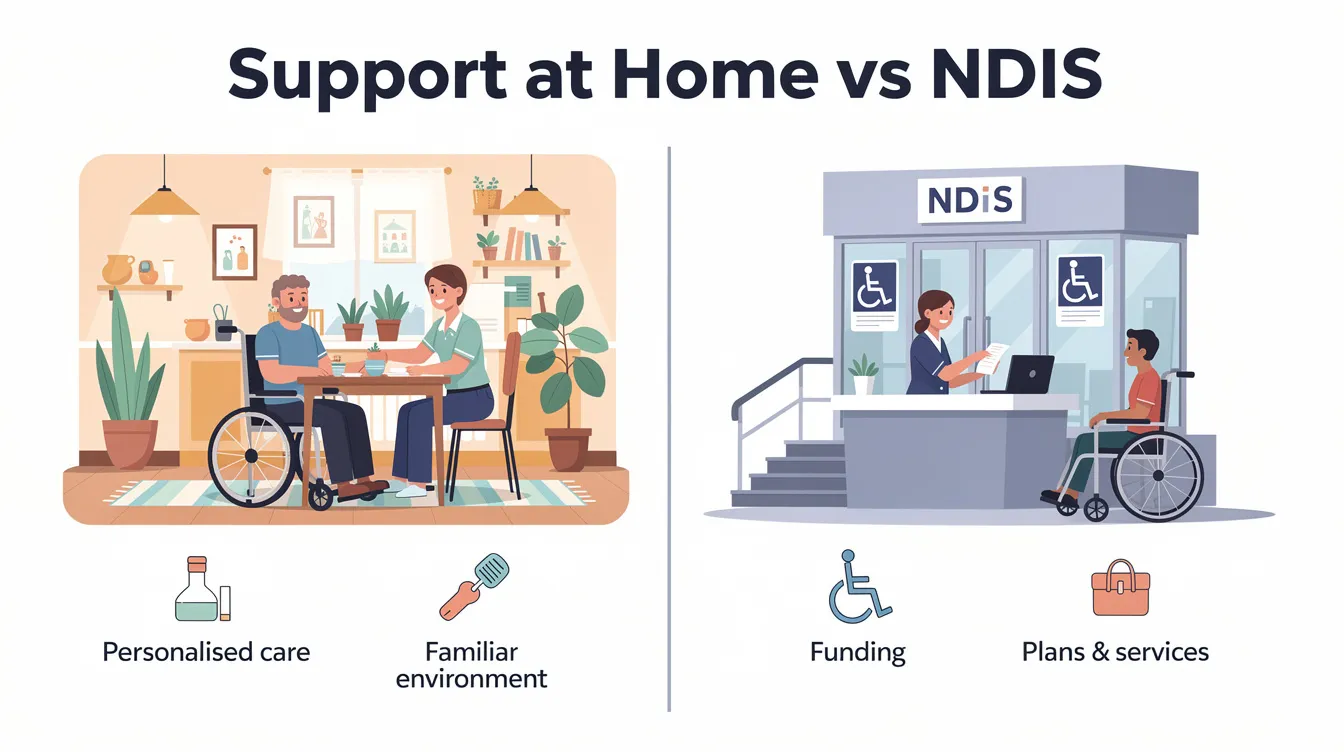
Here’s the deal: Support at Home is designed primarily for older Australians aged 65 and older (or 50+ for Aboriginal and Torres Strait Islander people) who need help to live safely and independently in their own home as they age. The National Disability Insurance Scheme (NDIS) is for people under 65 living with a permanent and significant disability that substantially reduces their ability to manage everyday tasks.
You generally cannot use Support at Home and NDIS for the same supports at the same time. Age plus the cause of your support needs usually decide which program is right.
- Under 65 with a significant disability? → NDIS is almost certainly your pathway.
- 65+ and need help due to ageing? → Support at Home is where you start.
At Re.Connect Support Services, we specialise in NDIS in-home support and personalised services and broader personalised support tailored to your unique needs, and can help you work out which pathway suits you before you apply. If you’re unsure, keep reading – or reach out to our team directly.
What is “Support at Home” in Australia?
Support at Home is the Australian Government’s new in-home aged care model, created to simplify and improve how older Australians access funding to stay independent at home. It consolidates several existing programs – including Home Care Packages (HCP) and much of the Commonwealth Home Support Programme (CHSP) – into a single, streamlined aged care system.
The program was legislated under the Aged Care Act 2024, following recommendations from the Royal Commission into Aged Care Quality and Safety. On 1 November 2025, HCP and Short-Term Restorative Care were replaced by Support at Home. The CHSP is scheduled to transition into Support at Home no earlier than 1 July 2027.
Key features at a glance:
- Age-based eligibility: Typically 65+ (or 50+ for Aboriginal and Torres Strait Islander people), assessed through My Aged Care. Support at Home is generally not available for younger individuals with disabilities.
- Focus on staying at home: Services help older people live independently and safely – covering personal care, domestic assistance, meal preparation, allied health services, home maintenance, transport, social support, respite, and minor home modifications.
- Structured funding: Support at Home funding is tiered and managed through approved aged-care providers, with 8 ongoing funding classifications (quarterly budgets ranging from roughly $2,757.89 at Classification 1 to $20,073.50 at Classification 8, as of 1 October 2026). Short-term pathways cover restorative care, assistive technology and home modifications, and end-of-life care.
- Participant contributions: Clinical care services are fully government funded with no out-of-pocket cost. Everyday living and independence supports require income-based contributions, subject to a lifetime cap of $140,652.80 for non-clinical services.
Support at Home is not a brand name or a provider’s own package – it is a formal government program replacing older schemes over time, aimed at individuals experiencing age-related functional decline.
What is the NDIS?
The National Disability Insurance Scheme is Australia’s national disability funding system. It provides individualised, government funded support for people with a permanent and significant disability, helping them build independence, participate in their community, and exercise choice and control over their lives – including in-home support.
NDIS funds individuals aged 7 to 65 with disabilities. To meet NDIS eligibility, you must:
- Be an Australian citizen, permanent resident, or hold a qualifying visa
- Be under 65 years old at the time you apply
- Have a permanent disability that substantially reduces your functional capacity in daily living
Examples of NDIS support relevant to home services include (alongside supports like specialised nutritional support under the NDIS):
- Personal care – help with showering, dressing, and meal preparation
- Domestic support – cleaning, laundry, and household support
- Community access – social support, transport, and everyday activities outside the home, often supported by NDIS-funded travel and transport assistance
- Assistive technology – devices and equipment to boost independence, with many participants using NDIS to access assistive technology that transforms independence at home
- Home modifications – funded by NDIS for accessibility improvements
- Therapy – occupational therapy, physiotherapy, speech pathology, and other allied health services, including specialist NDIS supports for people on the autism spectrum
The NDIS focuses on long-term goal achievement and capacity building. Every NDIS plan is built around the participant’s goals, and funding under the NDIS is tailored to individual needs and is not capped like Support at Home, supporting mental health recovery and community participation programs and a range of personalised mental health supports for NDIS participants.
At Re.Connect Support Services, we’re an experienced NDIS in-home support provider with a strong focus on healing, recovery and therapeutic services, delivered by a dedicated team of disability support workers. We help people step through using their plan for practical home-based services – from personal care rosters to community outings and skill-building at home, often through specialist NDIS support coordination and broader support coordination services that maximise your NDIS plan.
Support at Home vs NDIS: how they compare at a glance
Below is a side-by-side snapshot for anyone asking, “Which doorway do I walk through first?”
| Factor | Support at Home | NDIS |
|---|---|---|
| Best for | Older Australians needing daily living support due to ageing | People under 65 with a permanent and significant disability |
| Typical age when you apply | 65+ (50+ for Torres Strait Islander people and Aboriginal Australians) | Under 65 (children under 9 via Early Childhood partners) |
| Type of needs funded | Ageing-related: domestic assistance, personal care, meals, allied health, respite, home maintenance | Disability-related: personal care, therapy, assistive technology, complex support, home modifications, community access |
| How funding is set | Standardised: 8 ongoing funding levels plus short-term pathways; government-set price caps | Individualised NDIS plan based on assessed needs and participant’s goals; no strict universal levels |
| Who manages the money | Mostly provider-managed through an approved aged care provider | Self managed, plan managed, or NDIA-managed – participant chooses |
| Can you hold both at once? | Not for the same support needs; a person cannot access both NDIS and Home Care Packages simultaneously | Same: no duplicate funding for the same service |
| Key government gateway | My Aged Care → aged care assessment → Support at Home | NDIS Access Request via NDIS website or local partner |
| The main takeaway: Age and the cause of your support needs usually decide whether you start with My Aged Care’s Support at Home pathway or the NDIS. These two programs serve fundamentally different age groups and different eligibility criteria. |
Decisive factor 1: Age and eligibility rules
Age is usually the first filter – and often the clearest key difference – when choosing between Support at Home and the NDIS.
Support at Home eligibility:
- Aged Care is for individuals aged 65 and over (or 50+ for Aboriginal and Torres Strait Islander people). Eligibility requires an assessment by the Aged Care Assessment Team (ACAT) through My Aged Care. Support at Home is aimed at individuals experiencing age-related functional decline.
- Existing Home Care Package and CHSP users will largely be transitioned into Support at Home without needing a fresh eligibility assessment – their care is simply reclassified under the new system.
NDIS eligibility criteria:
- NDIS applicants must be under 65 years old when they first apply and must reside in Australia. They must have a permanent and significant disability that substantially affects daily functioning.
- Children under 9 with developmental delay access support through Early Childhood partners.
- Crucially, NDIS participants can continue receiving support after turning 65 – as long as they entered the scheme before that birthday and disability remains their primary support driver.
Overlap and edge cases:
- Someone aged 63 with a long-term disability should seriously consider applying for the NDIS now, rather than waiting for Support at Home. Entering the NDIS before 65 can preserve access to disability supports well beyond that age.
- Individuals over 65 typically transition to aged care services. A new disability onset after 65 usually means Support at Home (not the NDIS) is the primary path.
Winner: NDIS for people under 65 with a disability; Support at Home for people 65+ whose main challenges are age-related. The trade-off is that age, not preference, mostly decides this one.
Decisive factor 2: What gets funded at home (and how flexible it is)
The type and flexibility of in-home support matter enormously – especially for families weighing up whether a loved one needs basic support to stay safe at home, or more complex support tailored around building skills and independence using NDIS Core Supports for daily living and participation.
Support at Home in-home supports:
Home support focuses on practical daily assistance and basic personal care. Services include personalised in-home care and domestic assistance, meal preparation, home maintenance, transport, social support, allied health services, respite, assistive technology, and minor home modifications. Short-term pathways provide restorative care (to regain function), an AT-HM scheme (with caps from ~$513 to ~$15,390 depending on complexity), and an End-of-Life Pathway offering up to $25,736.57 over 12–16 weeks.
Support at Home provides localised help with more restricted budget allocations. Supports are tied to assessed care needs and set within standardised program rules and price caps – there is less room to “design your own” package. Home care packages previously operated on four standardized funding levels; the new system uses eight.
NDIS in-home supports:
NDIS funds personal care assistance for individuals with disabilities, plus community access, therapy, assistive technology funding for independence, complex home modifications for accessibility improvements, Supported Independent Living (SIL) options such as SIL homes in Adelaide for adults needing daily support, and transport-related assistance for participants. Supports are tailored to individual needs and the participant’s goals – for example, capacity building supports such as learning to cook independently versus simply receiving meal delivery.
Funding under the NDIS is tailored to individual needs and is not capped like Support at Home. Within each core supports budget category, participants have a higher level of flexibility to spend on what is “reasonable and necessary” for achieving their goals, which aligns closely with the scheme’s focus on Improved Life Choices and greater independence.
Both programs can fund very similar practical tasks – help with showering, household support, meal preparation, or assistive technology to increase independence at home and other assistive technology devices that enhance daily living – but the reasoning and rules behind that funding are different: one is built around ageing, the other around disability goals.
Winner: NDIS for flexibility and goal-focused home support; Support at Home for simpler, more standardised home help as you age. The trade-off is that Support at Home’s structure may feel more straightforward for people who just want reliable, everyday assistance without managing a detailed plan.
Decisive factor 3: Control, choice of providers and fees
How much say you have over your budget, which providers you use, and what you pay out of pocket – these factors strongly influence which system feels better for a person or their families.
Support at Home – control and costs:
- Care plans are typically coordinated and managed by an approved aged care provider. The government subsidy flows to the provider, with the participant contributing basic fees and possible income-tested fees for non-clinical aged care services.
- Clinical care services (nursing, allied health) carry no participant contribution. Everyday living and independence supports attract contributions based on income and assets, up to the lifetime cap of $140,652.80.
- Participants can choose their aged care provider, but there is less freedom to self-manage individual invoices or buy from unregistered support workers. The system ensures compliance with aged care quality standards.
NDIS – control and costs:
- NDIS funding can be self-managed, plan-managed, or NDIA-managed. Self managed participants handle paying providers, manage invoices, and can choose from both registered and unregistered providers. Plan managed participants have a funded plan manager handling finances while still accessing a wide range of providers. NDIA-managed participants use registered providers only, and many people choose to work with NDIS support coordinators who simplify budgeting and provider choices.
- NDIS does not means-test eligibility for funding. There are no income-based fees for having a plan – though usual living costs like rent and groceries are not funded.
- NDIS allows participants maximum choice and control over their providers and supports. Self managed NDIS participants can hire their own support workers and negotiate hourly rates, which is not how Support at Home typically works.
Practical implications: Support at Home may be simpler for people who prefer not to manage budgets, but can feel less personalised in provider choice. NDIS offers more control – but also more responsibility, especially for those who choose to self-manage.
Winner: NDIS if you want maximum choice and control; Support at Home if you prefer government-regulated packages with providers handling the admin. The trade-off is that greater flexibility in the NDIS comes with greater administrative responsibility.
Decisive factor 4: Using Support at Home and NDIS together (or switching)
One of the most common questions families ask: “Can we double dip – or stack both programs for more hours at home?”
The general rule:
A person cannot access both NDIS and Home Care Packages simultaneously for the same support needs. Home support services and the NDIS operate under distinct rules and eligibility criteria – different legislation (the Aged Care Act for Support at Home, the NDIS Act for the NDIS) – and are designed to complement, not duplicate, each other.
Common real-world patterns:
- People under 65 with disability: The NDIS is usually the primary source of ongoing support and NDIS funding for in-home help. Any additional aged care supports are more likely via family or private arrangements until they reach aged-care age.
- NDIS participants approaching 65: They can often choose to remain with the NDIS or move to aged care pathways like Support at Home, depending on whether disability or ageing is the main driver. Transitioning from NDIS to aged care requires an assessment process.
- People already on HCP services or CHSP when Support at Home starts: They will be transitioned within the aged care system, not to the NDIS.
- Edge cases: A small number of people may interact with both systems for genuinely different things (e.g., disability supports from NDIS and high-quality elderly care at home), but double funding the same service is never allowed. Families in these situations often benefit from drawing on practical articles and resources in the Re.Connect Support Services blog to understand how the systems interact.
Winner: It depends. NDIS if disability is the main driver of your needs before 65, Support at Home once ageing is the primary focus. The key is choosing one main pathway for home support at any given time, and understanding that general home support services and the NDIS serve fundamentally different purposes and eligibility.
Support at Home vs NDIS: which should you choose?
Age plus cause of your support needs usually decide which pathway works best. Here is the decision guide:
- Choose NDIS if:
- You’re under 65 and live with a permanent and significant disability affecting daily functioning.
- You want goal-focused support – capacity building, employment, social connection – as well as help at home.
- You’re comfortable, or have support, to manage a personalised NDIS plan and exercise more choice over providers.
- You want to receive funding tailored to your individual needs, with no means testing.
- Choose Support at Home if:
- You’re 65+ (or 50+ for Torres Strait Islander people and Aboriginal Australians) and mainly need help to stay independent and live safely in your own home due to ageing.
- You prefer a simpler, government-regulated package managed by an approved aged care provider, with additional support structured around assessed care levels.
- You’re already on CHSP or a Home Care Package and will be transitioned into Support at Home when it commences.
- Support at Home focuses on everyday age-related support needs, and that matches your situation.
There is no “wrong” doorway – just a better fit. If you think you or someone you care about may be NDIS-eligible, Re.Connect Support Services can help you plan practical in-home supports aligned with your goals, drawing on our broader mission to empower people to reclaim their independence and quality of life. Reach out to our team to talk through your situation and next steps.
Frequently asked questions about Support at Home vs NDIS
Quick answers to the most common follow-up questions families ask when weighing up their options.
Can I be on Support at Home and the NDIS at the same time?
In most cases, you will have one main government-funded program paying for your ongoing support at any given time. You cannot claim the same service – such as cleaning, personal care, or domestic support – from both programs simultaneously. There may be rare edge cases, for example where existing NDIS participants are ageing and certain disability supports continue alongside limited aged care supports for different needs. Always check official guidance via My Aged Care and the NDIS websites for the latest rules. Re.Connect can help NDIS participants understand their home support options.
I’m 63 with a long-term disability – should I apply for NDIS or wait for Support at Home?
If you’re under 65 with a permanent disability, you should consider applying for the NDIS as early as possible rather than waiting for aged care programs. Entering the NDIS before 65 can allow you to stay in the scheme beyond 65, retaining access to disability-specific supports that may not be available through Support at Home. Use the NDIS eligibility checker to review up-to-date criteria.
Does Support at Home replace Home Care Packages and CHSP?
Yes. Support at Home is the Australian Government’s plan to streamline several existing in-home aged care services. Home Care Packages and Short-Term Restorative Care were replaced on 1 November 2025. The Commonwealth Home Support Programme is scheduled to transition no earlier than 1 July 2027. Existing clients will not be left without care – they are being transitioned with communication from their providers and My Aged Care. Check the Department of Health’s Support at Home page for the latest confirmed dates and details.
What if my needs change – can I move from NDIS to Support at Home or vice versa?
NDIS participants approaching 65 may be offered the choice to stay with the NDIS or move to aged care pathways, depending on whether disability or ageing is the primary driver and the policies at that time. Transitioning from NDIS to aged care requires an assessment process through My Aged Care. Someone who becomes disabled after 65 will usually access help via Support at Home, not via a new NDIS plan. Reassessment is possible in both systems if your needs change – for example, needing more hours at home or new equipment. Re.Connect Support Services can help current or prospective NDIS participants prepare for reviews, navigate recent changes to NDIS policies and eligibility, and adjust coordinated support when significant changes happen.
How can Re.Connect Support Services help me decide?
Re.Connect Support Services offers free, friendly conversations – by phone or online – to help people under 65 work out if the NDIS is the right pathway for in-home support and other personalised care options across disability, aged care and mental health. We help turn NDIS plan goals into practical weekly home routines: personal care rosters, community connection and engagement activities, skill-building at home, and more, while providing support coordination that helps you maximise NDIS funding. We do not control government eligibility decisions, but we can help you arrive at assessments prepared and informed. Get in touch with our team to talk through your situation and next steps.